
Monash researchers receive 2024 Diabetes Australia Research Program grants
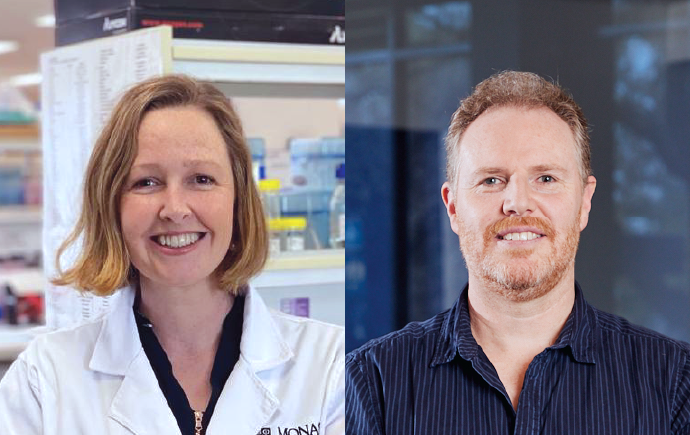
L-R: Dr Sarah Turpin-Nolan and Dr Miles De Blasio.
12 February 2024
Two researchers from the Monash Institute of Pharmaceutical Sciences (MIPS) have received 2024 Diabetes Australia Research Program (DARP) grants to advance research across a range of diabetes related complications.
Dr Miles De Blasio is undertaking research into heart failure experienced by people living with diabetes, while Dr Sarah Turpin-Nolan and team are studying new strategies to combat obesity and metabolic disease.
Dr De Blasio’s grant will enable him to explore cardiac mitochondrial dysfunction in the setting of diabetes. Mitochondria are membrane-bound cell organelles that power the cell’s biochemical reactions. These mitochondria become dysfunctional in the hearts of some people living with diabetes.
Dr De Blasio will utilise mitochondria-targeted drugs (SS31, SkQ1, AP39) that bring about pre-clinical improvements in diabetic retinopathy, nephropathy, and other pathologies. These medications will now be investigated to explore if they can limit cardiac complications associated with diabetes.
“Diabetes-related heart failure is the major cause of morbidity and mortality in people living with diabetes,” Dr De Blasio said.
“With more than 1.5 million Australians living with diabetes, and high rates of cardiac complications, improved prevention or treatment of those diabetes-related complications is urgently needed.”
Dr Sarah Turpin-Nolan is leading a team to help the 66 percent of Australians living with overweight and obesity, as well as the billions worldwide, by focusing on ceramides, a family of lipid molecules that are found in high concentrations in cells that do not use glucose properly.
“This research has identified a new intervention site and therapy to address the critical importance of reducing metabolic disease. What we learn from this research could alleviate the burden on the healthcare system and provide new therapeutic options to combat multiple metabolic-associated diseases,” Dr Turpin-Nolan said.
“Specifically, intestinal ceramide manipulation in obese mice reduces fat storage in the liver and restores the body’s ability to process glucose.”
There are more than 1.3 million Australians living with type 2 diabetes, which can be prevented or delayed in about 60 per cent of cases through healthy eating and an active lifestyle. Complications of the condition can include heart and kidney disease, stroke, amputations, vision loss and depression.
“Research is critical in our fight to drive change to prevent, treat and, ultimately, cure diabetes,” Ms Cain said.
Diabetes Australia has been funding diabetes research for more than 30 years through DARP grants.
“Over the past 10 years alone, Diabetes Australia has invested more than $30 million in supporting nearly 500 critical research initiatives across all types of diabetes,” Ms Cain said.
Diabetes Australia Group CEO Justine Cain said the successful DARP recipients were undertaking work that would change the lives of people with diabetes.
“Research is critical in our fight to drive change to prevent, treat and, ultimately, cure diabetes,” Ms Cain said.
Diabetes Australia has been funding diabetes research for more than 30 years through DARP grants.
“Over the past 10 years alone, Diabetes Australia has invested more than $30 million in supporting nearly 500 critical research initiatives across all types of diabetes,” Ms Cain said.
Diabetes Australia has launched a new campaign calling for more research funding called ‘Diabetes Research Changes Lives’. Members of the community can also support diabetes research by making a donation. Find out more about how to support us.
Credit: This press release was formulated press releases originally developed by Diabetes Australia. To read more Diabetes Australia news visit: https://www.diabetesaustralia.com.au/news/
ENDS