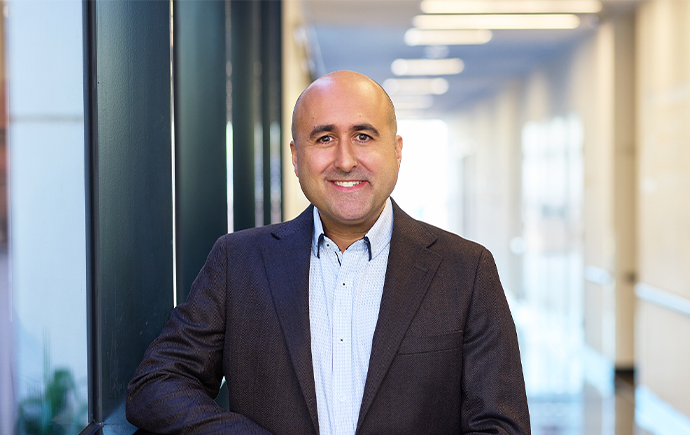
A seat at the head of the table—with Dr Jae Pyun
An early-career academic rarely finds themselves a key liaison between two countries. One might argue that even seasoned professors would struggle with the task. Yet just a few years out of his PhD and into his academic-teaching career, Dr Jae Pyun is taking such roles in his stride.
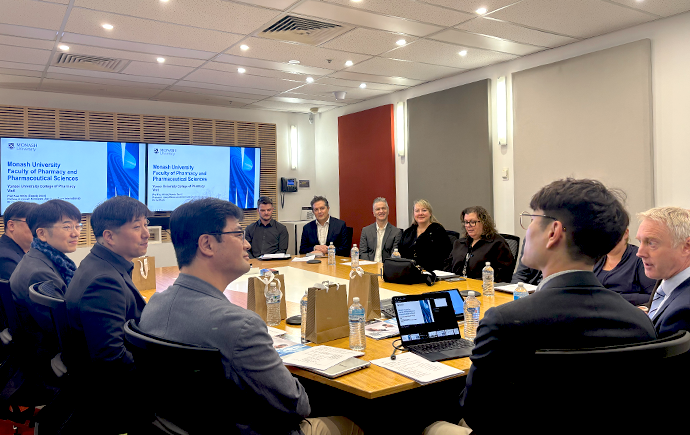
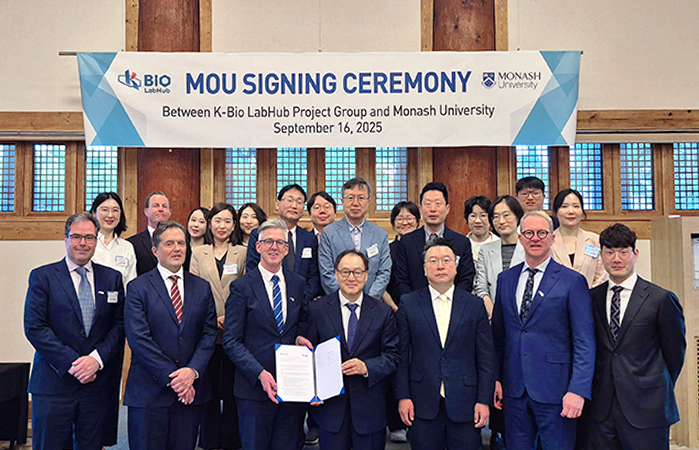 This year saw the formation of a new scientific relationship between Australia and South Korea, beginning with the signing of a Memorandum of Understanding (MoU) between Monash University and K-Bio Lab Hub, a major South Korean government-backed biotech incubator. The man at the centre of it all is Jae, whose unique ability to facilitate such conversations has positioned him as a bridge between two worlds. On a grey November day with a hot Sammy’s coffee in hand, he showed me what he sees from his seat at the head of the table.
CAITLIN: Jae, it’s nice to see you! Thanks for making the time.
JAE: It’s good to be here.
CAITLIN: How are you holding up? A little more free after the teaching semester?
JAE: Well yes, but now there’s marking to do and a whole lot of planning for next year! But it’s good, it’s been a big year.
CAITLIN: September was a pretty big month with the signing of the MoU between Monash and K-Bio Lab Hub.
JAE: It was, and things haven’t slowed down since! After the signing in September, the K-Bio Lab Hub director and a few of their startup company CEOs came to visit us. The Victorian State Government invited them over for the AusBiotech conference last month, to have a look at our biomedical ecosystem and clinical trials capabilities. The Korean delegates wanted to see how the state will be able to accommodate them and facilitate their growth, because in April 2026 we’re looking at welcoming the first three to five biotech startup companies from Korea.
CAITLIN: That’s very soon!
JAE: Yeah, there’s a lot of work to be done by then, but they’re very keen to start utilising the partnership we have with them. The MoU was designed so that K-Bio Lab Hub can have access to research infrastructure and networks through Monash, and have an office space where their member companies can set up base and go through the motions to get their drug candidates through clinical trials. They’re intending on having up to thirty companies established here by 2030.
CAITLIN: That sounds really exciting, it’s only been a couple of months since the signing but things already seem well on their way. It does sound like a lot of work though—is this project the main focus of your role at the university?
JAE: So my main role is an Education-Focused Lecturer. Primarily I do a lot of teaching and that’s what I’m really passionate about. And I’ve also been diving pretty deep into my research, which involves building custom large language models and AI tools for educators and students. A fraction of my role is dedicated to engagement, and that’s where a lot of the collaborations with the Korean networks have emerged.
CAITLIN: I see. How did this all come about? I mean, engagements is one thing, but government relations isn’t something that your average early-career academic tends to be involved in.
JAE: Yeah look, it just happened. It wasn’t an idea of mine, or a plan of mine at all. During my PhD, my co-supervisor Jen Short was invited to give a talk about the mRNA workforce training centre that Monash established in response to the COVID-19 pandemic. The World Health Organisation had designated Incheon, Songdo in Korea to be a global hub for mRNA vaccine development. Jen wasn’t able to attend one of the conferences so she invited me to represent Monash. I still remember the Zoom meeting with all the Korean delegates and directors—Jen was running a couple of minutes late, and when they saw me they automatically started talking to me in Korean. I didn’t know how to respond because they didn’t realise I was part of Monash!
 CAITLIN: [Laughs] What an introduction!
JAE: During that meeting they invited me to come over and give a talk at Yonsei University, where Jen had connections with K-NIBRT, which is the organisation co-located with K-Bio Lab Hub. After the symposium there was a networking dinner, where I exchanged business cards with the director of K-Bio Lab Hub.
I kept in contact with him, and their group came to visit Monash during last year’s Ausbiotech conference. During that visit the Consulate General of Korea organised an event for the Korean delegates and Korean academics in Melbourne, and I was invited to give a talk there. That’s when I went and spoke about MIPS, about our Faculty, and that’s where it all started.
The K-Bio Lab Hub director basically reached out and said ‘Hey, you guys are world-renowned, you’ve got a great reputation. It looks like your institute's research is really aligned with what our member companies are looking for.’ And because the Consulate General was involved, the Korean Minister for Health and Welfare and government organisations got involved and the Victorian State Government was very interested in the discussions. And I had the task of getting everyone aligned.
CAITLIN: It sounds like it would have been a huge task, linking all the right people.
JAE: [Laughs] Yeah, and I didn’t even know who the right people were at first! I was just doing what I felt was right. Looking at things with a critical eye, I saw there was really no loss here, it was a win-win situation. And I felt that having this international collaboration just made sense, it would be synergistic.
CAITLIN: In what ways?
JAE: K-Bio Lab Hub has strong financial backing and support from the Korean government, who are the second-biggest R&D investors by percentage of GDP in the world. And because they invest heavily into biotech and commercialisation, it’s allowed for the development of many candidate drugs and biotech companies. Korea has amazing scientists but funding isn’t channeled as much into university research, so their research output is not as robust. Australia on the other hand, is amazing at research and the novel things people work on. We have great infrastructure here and our clinical trials and regulatory sector is highly renowned, but commercialisation and manufacturing isn’t quite at the level of other countries. That’s where I believe a lot of the mutual benefit to be. There’s a lot to be learned on both sides.
CAITLIN: How did you go about setting up these conversations between K-Bio Lab Hub and Monash?
JAE: I guess the biggest thing was being able to speak Korean and exchange emails in a professional manner. And not in the way of a language barrier. They really didn’t need a translator, their English was great. It was more around the subtleties, understanding what people really want behind the high-level professional language, and navigating the back and forths without tension. I think it’s a combination of managing differences in policy, process and culture.
CAITLIN: Oh, that’s interesting.
JAE: For example in many parts of Asia, MoUs get signed quite often. It’s a very common thing. It’s more of an initiator than an official agreement, because they need it to begin initiatives. Whereas for Monash, an MoU has to go through the right levels, which consist of multiple levels of meetings and approvals as well the involvement of global engagement and legal teams. They need a vision of a tangible success story before signing off on it which absolutely makes sense. But the Korean colleagues didn’t understand that and thought it would be the same process and level of approval. And so timing-wise, it’s very difficult to navigate, because here in Australia, MoUs aren’t seen as just a chance to shake hands and take a photo.
CAITLIN: [Laughs] It does make for a great photo!
JAE: It does. But these interactions, I couldn’t write it up into a playbook and say this is what you have to do. It’s all nuance, trying to relay the priorities of both parties taking into account the bilateral interests without being pushy.
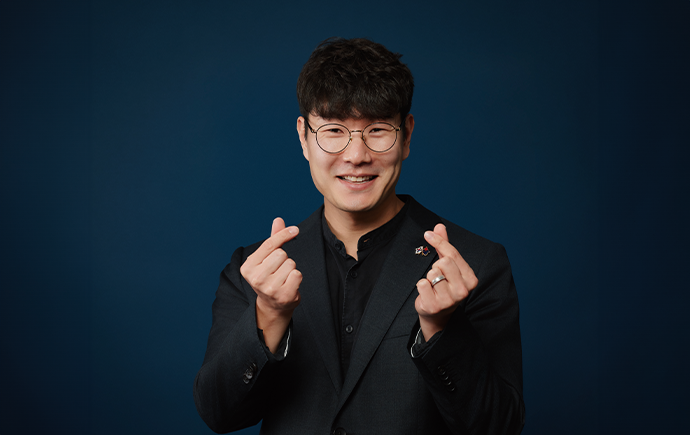 CAITLIN: Being Korean and also from New Zealand, how has this experience been for you personally?
JAE: I feel like there’s a really strong sense of purpose in this role, I’ve definitely connected with and embraced my cultural heritage a lot more. And I don’t know how to not sound cheesy, but it’s really brought me out of my shell. Being able to have those high-level conversations in Korean, mixed with the small-talk I get from my New Zealand culture, and just being a genuine, curious listener—I feel like that’s really what’s allowed me to do this.
CAITLIN: For sure, and also being open to these opportunities, and being willing to step up to the plate.
JAE: There really aren’t many opportunities like these. If I hadn’t taken on the roles and proposals and initiatives that were coming through my emails, I wouldn’t have been able to meet all these fascinating people. I’ve met some really high-calibre individuals who are leading the field, leading massive organisations, people like directors and government officials. What excites me is being able to learn from them and pick their brains. Just listening to them and how they see things is a lesson to me. The number of business cards I’ve collected—it’s like a snowball rolling down a hill! The more you give out, the more contacts you get, and it just gets bigger and bigger. And I feel like that’s what’s happening with these collaborations too.
CAITLIN: It’s pretty incredible that you’ve been able to bridge these two worlds of science—and as a passion-project, essentially!
JAE: It’s been an immensely rewarding journey, and it’s really been made possible by the support and trust of the Faculty. They consistently welcome conversation and collaboration rather than closing doors, and it fosters a culture where even an early-career academic like me is genuinely heard and encouraged.
I’m particularly grateful for the support of Professor Chris Porter, Professor Joe Nicolazzo and Rachel Ung, who entrusted me to lead discussions and helped facilitate these initiatives. And I’m also deeply appreciative of the invaluable contributions of Michael Simmonds from Global Engagement, whose efforts were instrumental in driving this work forward, and of Pro Vice-Chancellor Research Professor Mike Ryan, whose endorsement and support have been crucial in enabling these opportunities to grow.
CAITLIN: We have some incredible people here at Parkville, it’s so great to hear how the Faculty has supported you in this. Before you go I wanted to ask, what’s next for you?
JAE: I do want to see things through, to be able to say I’ve played my small part in facilitating the strengthening of bilateral relations and the potential for scaling up of a startup biotech company. I feel like I’m still quite new and there is so much to learn—people say to me "you seem so young, how are you doing this?" and I think the answer is just staying curious and proactive.
I’ve always been very interested in not just my area, but also what others do in the Faculty. As an educator, knowing what the big initiatives are at MIPS is so important, because if you’re only engaging with what you teach, you can’t have conversations with students when they come to you with questions about what’s out there for them. I would love to keep doing what I’m doing with our Korean partners and collaborators. Hopefully the MoU won’t just be a piece of paper, and this all leads to something meaningful. And I feel like it will because it’s already in the works. It’s exciting to be part of such a big initiative.