
Australian invention leads to new US-based neuroscience company, Seaport Therapeutics
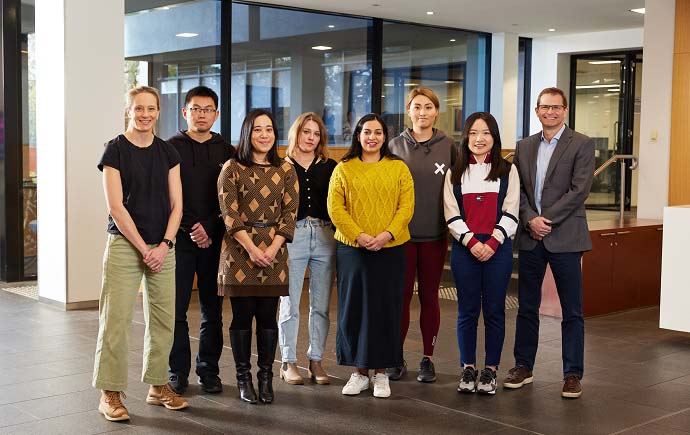
The Glyph team. L-R: Associate Professor Natalie Trevaskis, Dr Dan Zhen, Dr Nathania Leong, Vilena Ferreira, Dr Garima Sharma, Dr Enyuan Cao, Xiaotong Zhou and Professor Chris Porter (Dr Mitchell McInerney, Dr Luojuan Hu and Dr Sifei Han are not pictured).
17 January 2024
Boston-based biotherapeutics company, PureTech Health plc (Nasdaq: PRTC, LSE: PRTC), has announced the launch of Seaport Therapeutics - a new clinical-stage neuroscience company based around a unique drug delivery platform originally developed by Monash University researchers.
Seaport Therapeutics will use the proprietary GlyphTM platform to advance first and best-in-class drugs being developed for people with central nervous system (CNS) related conditions, but are currently being held back by key limitations such as negligible oral bioavailability or hepatotoxicity.
The Glyph platform, which was initially developed by Professor Chris Porter and his team at the Monash Institute of Pharmaceutical Sciences (MIPS), solves these limitations by enabling the oral administration of therapeutics that otherwise cannot be effectively administered orally.
Seaport’s pipeline of therapeutic candidates are designed to address the needs of patients across a range of neurological and neuropsychiatric conditions. These candidates include:
- LYT-300, an oral form of allopregnanolone for the treatment of neuropsychiatric and rare central nervous system conditions.
- LYT-310, an oral form of cannabidiol (CBD) for the treatment of epilepsies and other neurological indications.
- LYT-320, an oral form of agomelatine for the treatment of anxiety and mood disorders.
Professor Porter, Director of MIPS and Glyph co-inventor, said PureTech’s formation of Seaport Therapeutics is testament to the ongoing success of the Glyph platform since its inception.
“Since licensing the Glyph platform to PureTech in 2017, the MIPS team has worked closely with our colleagues at PureTech to help progress the platform and in particular to help advance LYT-300, an oral form of the drug allopregnanolone, which has now progressed through an initial Phase 2 clinical trial, and LYT-310, an enhanced oral form of cannabidiol. We are also delighted to see the recent nomination of LYT-320, a prodrug of agomelatine, as a Glyph candidate,” Professor Porter said.
“It has been really rewarding to see the Glyph technology being used to unlock the full potential of these drugs. The announcement of the formation of Seaport Therapeutics signals the next exciting chapter in this development with the aim of making much-needed treatments easier, more effective and more accessible for those living with a broad range of neurological conditions.”
The Glyph platform harnesses the body’s lymphatic system to bypass the liver and enable oral bioavailability.
“After conventional oral administration, these drugs are significantly metabolised by the liver before entering the systemic circulation. As a result, for drugs such as allopregnanolone, the only way to administer them is via lengthy and expensive intravenous infusions,” said Professor Porter.
“Glyph overcomes this issue by employing the lymphatic system’s natural lipid absorption and transport process to avoid this process of ‘first pass’ metabolism in the liver and thereby enable effective oral administration.”
In addition to Professor Porter, the team at Monash that developed the Glyph technology was led by Associate Professor Natalie Trevaskis and Dr Sifei Han and included Dr Luojuan Hu, Dr Dan Zheng, Dr Nathania Leong, Dr Garima Sharma, Dr Xiaotong Zhou, Dr Enyuan Cao and Dr Mitchell McInerney.
For further information, click here.
ENDS
About the Glyph™ Platform
Glyph is PureTech's lymphatic-targeting platform which is designed to employ the lymphatic system's natural lipid absorption and transport process to enable the oral administration of certain therapeutics. Glyph reversibly links a drug to a dietary fat molecule, creating a novel prodrug. The linked fat molecule re-routes the drug's normal path to the systemic circulation, bypassing the liver and instead moving from the gut into the lymphatic vessels that normally process dietary fats. PureTech believes this technology has the potential to provide a broadly applicable means of enhancing the bioavailability of certain orally administered drugs that would otherwise be limited by first-pass liver metabolism. PureTech is accelerating development of a Glyph portfolio that leverages validated efficacy, prioritizing highly characterized drugs to evaluate the ability of the Glyph technology to improve oral bioavailability or lymphatic targeting. PureTech's lead Glyph therapeutic candidate, LYT-300 (oral allopregnanolone), completed a randomized placebo-controlled, Phase 2a, proof-of-concept trial using a validated clinical model of anxiety in healthy volunteers in 2023. A Phase 2 clinical trial of LYT-300 in FXTAS in collaboration with the University of California, Davis, is expected to initiate in 2024. PureTech has now generated seven CNS programs based on the Glyph platform. PureTech has a robust intellectual property (IP) portfolio that includes licensed patents as well as wholly owned IP, covering the Glyph technology platform, which is based on the pioneering research of Christopher Porter, PhD, and his research group at the Monash Institute of Pharmaceutical Sciences at Monash University. The Porter Research Group and collaborators have published research in Nature Metabolism, Angewandte Chemie and the Journal of Controlled Release supporting the Glyph platform's ability to directly target the lymphatic system with a variety of therapies.
About the Monash Institute of Pharmaceutical Sciences (MIPS)
MIPS houses over 450 researchers and graduate students across five major themes of activity in Pharmaceutical Sciences – Drug Discovery Biology, Medicinal Chemistry, Drug Candidate Optimisation, Drug Delivery, Disposition and Dynamics and Medicine Use and Safety. Therapeutically, MIPS strengths lie in neuroscience and mental health, cardiovascular and metabolic health, and global health. Major capabilities lie in G-protein coupled receptor (GPCR) biology, synthetic medicinal chemistry, fragment-based drug design, ADME-informed lead optimisation, drug formulation and delivery (including nanomedicine), and optimised medicine use and safety in community and clinical settings. MIPS is committed to research translation and industry engagement and recent successes include the spin out/start-up companies Cincera, Septerna, Ankere and Inosi and significant ongoing relationships with local and international companies including Takeda, Servier, CSL, Starpharma, PureTech and Polyactiva.
About PureTech Health
PureTech is a clinical-stage biotherapeutics company dedicated to giving life to new classes of medicine to change the lives of patients with devastating diseases. The Company has created a broad and deep pipeline through its experienced research and development team and its extensive network of scientists, clinicians and industry leaders that is being advanced both internally and through its Founded Entities. PureTech's R&D engine has resulted in the development of 28 therapeutics and therapeutic candidates, including two (Plenity® and EndeavorRx®) that have received both US FDA clearance and European marketing authorization and a third (KarXT) that has been filed for FDA approval. A number of these programs are being advanced by PureTech or its Founded Entities in various indications and stages of clinical development, including registration enabling studies. All of the underlying programs and platforms that resulted in this pipeline of therapeutic candidates were initially identified or discovered and then advanced by the PureTech team through key validation points.