Course Directors' updates
Dr Dan Malone, Pharmacy Course Director, and Dr Ian Larson and Dr Tony Hughes, Pharmaceutical Science Course Directors, discuss some of the key trends in learning within their courses and reflect on teaching during 2022.
The Faculty of Pharmacy and Pharmaceutical Sciences has a strong education commitment to students and those enrolled in one of our programs, can expect their learning to be underpinned by our four pillars of education: active learning, experiential learning, skills coaching and employability. We speak to Course Directors, Dr Dan Malone, Dr Ian Larson and Dr Tony Hughes, about how some of these aspects feature in their programs.
Rethinking delivery modes, community and authentic assessment

L-R: Dr Dan Malone, Dr Ian Larson, Dr Tony Hughes
Dr Dan Malone is Course Director for the Bachelor of Pharmacy/Master of Pharmacy degree and says that the Faculty is still seeing the impact of COVID-19 on students.
“We were forced to change our delivery mode through COVID, and now we’re focused on what elements we retain, change or return to - to create an ideal learning environment,” Malone says.
“Students at all levels have been impacted in different ways – some thrived and were motivated and engaged, but more students than usual were disengaged and have faced educational or mental health issues.”
“We’re looking at how we can better support those students who have been impacted and ensure they’re ready when they go on placement.”
Dr Malone says creating a sense of community is also an important factor when it comes to effective teaching and highlights a project from colleagues Dr Nel Karunaratne, Dr Betty Exintaris and Dr Suzanne Caliph, that aims to foster a sense of community around pharmacy and pharmaceutical science students in first year, aimed particularly at students from overseas. This is known as the Parkville International and Exchange Students (PIES) group that supports students by building a community through connection, various events and sharing of information.
“One of the benefits of a small campus and a degree with the same cohort throughout the life of the course is students get to know each other and their teachers quite well,” Dr Malone says.
“We know that, particularly for International students, if you’re feeling lost and lonely, you may not achieve as well,” Dr Malone says. “Pharmacy and our campus at Parkville have always been multicultural, and our student societies also feed into this important sense of community.”
Another educational trend Dr Malone highlights is the push for authenticity in assessment - a university-wide initiative driven by Professor Sharon Pickering, Deputy Vice-Chancellor (Education) and Senior Vice-President at Monash.
“Rather than solely using exams that only test lower order skills like remembering and understanding information, we’re shifting towards more authentic assessment styles that test application of knowledge, like oral clinical exams and role play.”
While Dr Malone says this approach is not new for the Faculty, they’re giving careful thought to where these are placed in the degrees and how they assess students to see if they’re ready to go on placement.
Dr Malone says the Faculty maintains strong industry links – through the Pharmacy Stakeholder Advisory Group - to ensure student skills match pharmacy workforce needs.
“This group provides valuable feedback on our students, but has also revealed that there’s a shortage of pharmacists across the board right now, across community, hospitals and pharmaceutical companies,” Dr Malone says.
An increasing number of Pharmacy Graduates are opting to work part-time due to COVID, lifestyle or further study, further compounding the pharmacist shortage.
“It’s a particular issue in rural areas, so we are reintroducing rural and regional placements next year and already have students interested, which will hopefully assist,” Dr Malone concludes.
Experiential learning leads to employability
Dr Ian Larson is the newly appointed Course Director of the Bachelor of Pharmaceutical Science. While the course has been running since 2000, it’s undergone numerous iterations over more than two decades, including name and subject changes, to end up in its current form as a well-rounded three-year undergraduate degree, with the option of an honours year.
“It’s a course you can’t ignore,” says Dr Larson. “Intake numbers are increasing year-on-year. All of our graduates get jobs - they are in demand.”
“It is a vocational course, so experiential learning is key because our job is to prepare people for employment and the workplace,” Dr Larson says.
“Anecdotally, we know that the majority of our students (around two-thirds to three-quarters) find jobs in the industry,” Dr Larson says. “Around a quarter, to a third, go on to higher degree research.”
Dr Larson says the course has a three-step process that focuses on the importance of experiential learning to lead to employability.
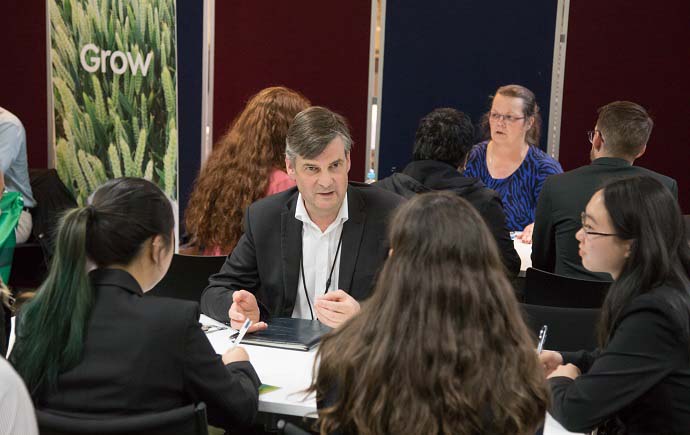
BPharmSci students met with industry representatives at the 2018 Employability Week
The first step is “Employability Week”, an event where Faculty invites industry partners and students to present to second-year students each November.
“There are presentations, networking events and workplace tours to give students a taste of the industry,” he explains.
The second step is a unique subject in third year, where students build on the theory they’ve learned by designing an experiment to solve a real-life, current problem posed by industry partners.
“They work in teams, research the problem, come up with a plan, design it, and go into the lab and work with real materials to attempt to solve the problem,” Dr Larson says. “As it’s a current problem, no one knows the answer, so they work with an industry mentor to solve the problem and present their findings.”
The third step is a four-week workplace placement that the students undertake in third year.
Dr Larson says the Faculty is also exploring the idea, in consultation with industry, of developing “badges” or micro qualifications, so students can gain and demonstrate their skills to potential employers.
“These will be for workplace-relevant measurable skills, like lab skills,” Dr Larson explains. “Industry would know with confidence that a student had this particular skill if students had opted into working towards a badge for it.”
Setting careers through a holistic and active approach to learning
Dr Tony Hughes joined Monash in 2020 and, as Course Director, has spent much of his time at Monash to date getting the new two-year Master of Pharmaceutical Science up and running.
“It’s been a very exciting time for the faculty, rolling out the first standalone coursework graduate degree in pharmaceutical science,” he says. “The buy-in from my colleagues in the faculty has been fantastic, and student numbers have surpassed expectations.”
Those taking the Master degree specialise solely in the science behind drug discovery and development, covering medicinal chemistry, pharmacology and formulation science.
“We had good feedback from the Bachelor Pharmaceutical Science, and we knew there was a demand for higher level skills,” he explains.
Dr Hughes says that while some students will find work in the pharmaceutical industry, just as many will aim for allied industries like cosmetics, food science or paints, which overlap when it comes to formulations.
Dr Hughes says like other Faculty courses, the Master of Pharmaceutical Science aims to set the students up for career success by using an “active learning” model.
“We have a diverse range of students and backgrounds starting the course, and the Faculty asks them to engage in a different style of learning to what they may have experienced before, without lectures or typical end-of-semester exams.”
Students analyse “prep” material before attending an “applied session” where learning is consolidated and responses shared through facilitated active class discussions. A third component involves a “workshop” where knowledge is applied. The course also involves work or research placements, with both proving popular options.
From hands-on work to analysing case studies, a scientific mindset and knowledge are key.
But, as Dr Hughes says, “it’s not just learning about science - we take a holistic approach.”
“We emphasise the importance of working in teams,” Dr Hughes says. “The challenge has been getting the students to fully appreciate what it is, and the value and power of working in teams.”
“Because Pharmaceutical Science is a human endeavour, we also look at the psychology of things and what drives the human component, because ultimately, these students are the ones who can change the industry to be more sustainable, socially responsible and ethical.”