
World first breakthrough for obesity treatment
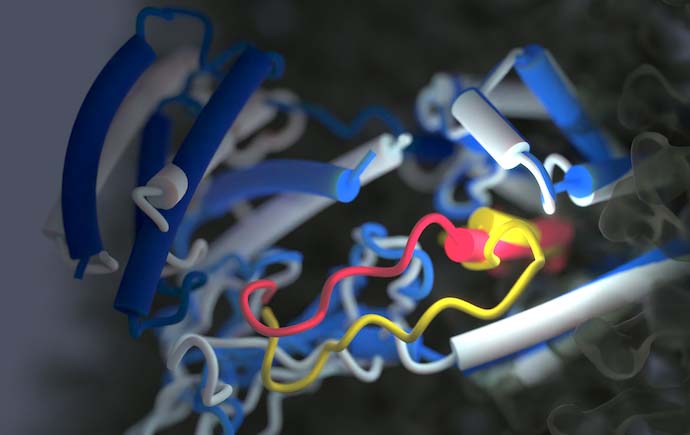
Amylin-template peptides (gold) activate amylin receptors (blue) through distinct mechanism to calcitonin-template peptides (red, peptide; light grey, amylin receptor). The image was created by Dr Sarah Piper.
A team of researchers from MIPS and the ARC Centre for Cryo-EM of Membrane Proteins (CCeMMP) published breakthrough, world-first research on a new obesity treatment in the prestigious journal Science in early 2022.
Obesity is a significant risk factor for developing and hampering control of many diseases, including cardiovascular disease, diabetes, and some cancers.
A class of drug candidates known as DACRAs, dual amylin and calcitonin receptor agonists have shown promise, with the peptide drug cagrilinide (Novo Nordisk) proving successful in clinical weight loss trials for obesity.
However, the details of how this class of drugs activate the different receptors was not known, therefore limiting their optimisation as a treatment for obesity.
Monash researchers tapped into significant recent advancements in cryo-electron microscopy (cryo-EM) to demonstrate for the first time that amylin-template peptides activate the receptors via distinct mechanisms from calcitonin-template peptides.
The study is an example of the enormous benefits of fundamental basic research in addressing significant unmet medical needs.
“To really understand how these drugs may work, we needed to visualise molecular level details of how the different types of template peptides were bound to each of the four different target receptors,” said Jianjun (Jason) Cao from MIPS, who was lead author of the study.
“This work will support the development of next-generation DACRA drugs as weapons to address the rising obesity epidemic,” said Professor Wootten, co-lead on the study and leader of the Monash node of the ARC CCeMMP.
The team collaborated with colleagues from the University of Tokyo and the University of Otago and was also supported by funding from the Australian Research Council and the National Health and Medical Research Council.
