Transforming pharmacy education: Graduates from the innovative new Bachelor of Pharmacy (Hons) / Master of Pharmacy join the workforce

Monash was the first Australian university to create and offer an integrated Bachelor of Pharmacy(Hons) / Master of Pharmacy, which reimagined, refined and replaced the Faculty’s existing Pharmacy degree. In 2022, the first student cohort to graduate from this award-winning vertical integrated master’s degree entered the workforce.
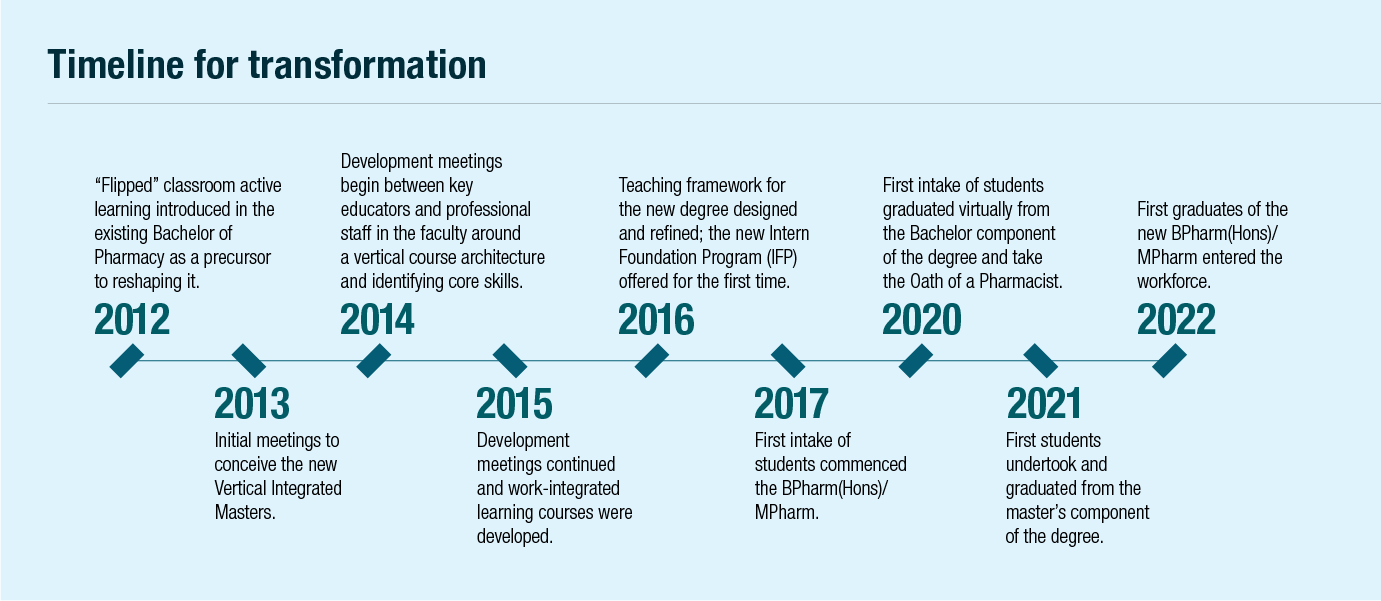
Launched in 2017 by the Faculty of Pharmacy and Pharmaceutical Sciences, the new Vertical Integrated Master (VIM) degree offers a rare pathway, allowing students to graduate with a master’s as well as a bachelor’s degree. Its unique integrated course architecture also means pharmacy students spend more time practising in healthcare settings and engaging in quality improvement activities, as well as developing “soft skills”.
Read the profiles of three VIM graduates here.
Two degrees in five years
Course Director Dr Dan Malone says that getting a whole new degree up and running was a long journey – one that began in 2012 with initial meetings about the concept of a VIM instigated by previous Course Director Professor Carl Kirkpatrick.
Dr Malone believes the new Bachelor of Pharmacy (Hons) / Master of Pharmacy degree is innovative in two key ways. Firstly, students graduate with both a bachelor’s and a master’s degree in the same timeframe it takes to register as a pharmacist, which is recognition of the higher level of learning and skills that these students have. Secondly, it takes an innovative and integrated approach to student learning.
Most pharmacy degrees in Australia offer a five-year pathway to registration as a pharmacist, and the new Monash degree was designed to take the same amount of time. However, instead of graduating with one degree, students graduate with two: a master’s and a bachelor’s (with honours). This offers Monash students a head start over other pharmacy graduates.
MPharm v MClinPharm: what’s the difference? The MPharm is part of the award-winning VIM, which prepares graduates to start their careers as registered pharmacists, so can only be studied as a continuation from Monash’s Bachelor of Pharmacy (Honours). For registered practising pharmacists who wish to further advance their practice, the Faculty offers another degree: a Master of Clinical Pharmacy (MClinPharm). Designed to propel pharmacists further into their careers, the MClinPharm allows students to develop specialist clinical pharmacy knowledge and skills in areas that are relevant to their current practice or future interests. |
|---|
Monash was able to design this unique program by adding higher level units from students’ third year of study. The ‘Inquiry and Innovation’ units students undertake across third and fourth year are research-based and offered at master’s level. Further, when the student undertakes their paid internship in their fifth year, they’re required to study a couple of units surplus to registration requirements, namely the ‘Intern Foundation Program’. These units give students opportunities to develop skills in more advanced and specialised areas of practice and also count towards them gaining a master’s qualification.
Making healthcare better

Dr Dan Malone (left) and Associate Professor Kirsten Galbraith
“Ultimately, the decision to introduce the VIM was about making healthcare better,” says Associate Professor Kirstie Galbraith, the Faculty of Pharmacy and Pharmaceutical Sciences’ Director of Experiential Development and Graduate Education.
Dr Malone says the process of redesigning the degree provided an opportunity to look in detail at course content and basic principles.
“Our objective was to completely transform the pharmacy curriculum so that all graduates had advanced knowledge and skills with which to improve pharmacy practice and healthcare services.”
The result was an emphasis on a patient-centred approach, which more explicitly links pharmacy content to patients and medicines.
“Pharmacy is a science, but it’s a health science,” Dr Malone says. “It’s about working with people so we have a focus on patient care.”
“We always need to be teaching with the patient in mind. We needed to provide the context of a patient and medicine in anything that was taught.”
This thinking plays out in early experiential placements that link on-campus learning to practice, enabling students to spend more time in healthcare settings and engaging in quality improvement activities.
Embedding soft skills and a culture of inquiry

Dr Malone believes that a focus on skill development is one factor that sets the Monash degree apart from others.
“Engagement with stakeholders from community and hospital pharmacy settings showed us that what employers are looking for is pharmacy graduates with both the practical skills and the soft skills required to work effectively within today’s healthcare settings,” he says.
“We knew our pharmacy graduates were smart, but the feedback from employers and other stakeholders was that they needed skill development to allow them to demonstrate this and put their knowledge into practice around things like teamwork, communications and problem-solving.”
The educational team focused on making these soft skills more overt and structuring the course around them, building a new degree from the ground up.
“The course went through a few iterations, but we used a core set of skills as the foundation, scaffolding and building on those, alongside the knowledge,” Associate Professor Galbraith explains.
“We whiteboarded key skills we wanted to develop in students and thought about how we could best get students taught, practised and assessed on those skills,” Dr Malone adds.
The degree hones in on skills defined in the acronym “POWER IT Inq”, which stands for problem-solving, oral and written communication skills, empathy, reflection, integrity, teamwork and inquiry, and aims to integrate these skills into all aspects of learning.
“The backgrounds and skills of students entering the degree really vary, so we needed to assess this early on and work in a personalised way to develop what is needed and set benchmarking or hurdle requirements along the way,” Dr Malone explains.
This is achieved through a skills coaching program, where groups of 10 students meet three times a semester with a skills coach. They discuss and reflect on the set of required skills and develop personalised learning plans for specific skills (e.g. teamwork, or oral or written communication skills).
“It’s another aspect that really distinguishes Monash from other Pharmacy degrees,” Dr Malone says.
“We encourage them to think about the skill: from what it is to the evidence behind where they are at and how they can achieve a better outcome.”
Students in the early years have an academic as their skills coach, while those in higher years are coached by pharmacy practitioners.
Reputation and innovation breed success
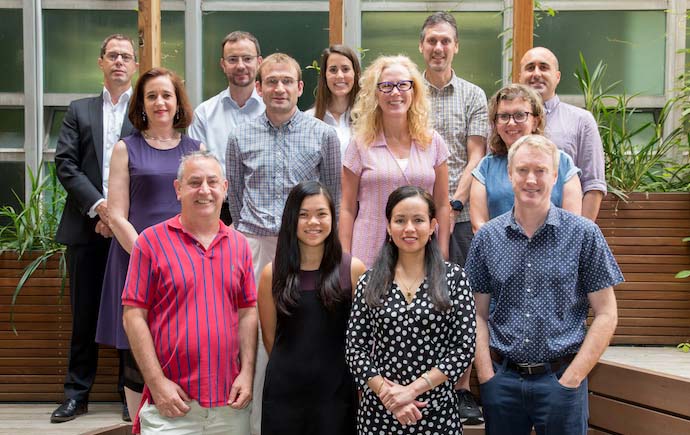
The VIM team in 2017. Back row: Professor Carl Kirkpatrick, Dr Dan Malone, Dr Andreia Bruno-Tomé, Dr Ian Larson, Associate Professor Joseph Nicolazzo; Middle row: Professor Kirsten Galbraith, Associate Professor Darren Creek, Professor Tina Brock, Dr Betty Exintaris; Front row: Dr Sab Ventura, Dr Vivienne Mak, Dr Suzanne Caliph, Professor Paul White
Both Dr Malone and Associate Professor Galbraith say that students routinely choose to undertake the VIM at Monash because of the Faculty’s strong reputation in both education and research.
“Our reputation gets students in the door,” Associate Professor Galbraith says.
Once they’re enrolled, the innovative new degree requires students to approach their learning differently.
“The degree requires students to interact and be engaged and responsible for their learning,” Dr Malone explains. “You won’t simply be sitting in a lecture being taught at.”
“We will help them engage, but the expectation is that they are involved in their learning from day one.”
Compared to many degrees, the attrition rate of students as the degree progresses is very small.
“We started our 2022 intake with 300 new students in first year, and we now have around 270,” Dr Malone explains. “We want our students to be passionate about pharmacy, so it’s ok if they decide it’s not for them and transfer out.”
Associate Professor Galbraith puts some of this success down to the course structure.
“This course demonstrates early on what it will take to be successful as a healthcare professional,” she explains. “Through teamwork, placements, and the emphasis on skills, students will realise early on if it's not right for them.”
All students graduate with a bachelor’s degree at the end of their fourth year. During their fifth (provisional registration) year, they undertake a paid internship in a community or hospital setting, complete an accredited Intern Training Program, and can undertake two extra work integrated learning units in order to graduate with a master’s degree.
Dr Malone says that, pleasingly, the vast majority of students choose this option.
“A high proportion of students, well over 90%, are going on to complete their masters.”
Lessons from transforming a degree In September 2021, nine of the course collaborators contributed to a journal article entitled “Development of a Vertically Integrated Pharmacy Degree”. Publishing about the degree transformation process and lessons learned should help others looking to transform their health curriculum. As the collaborators wrote, “Whilst curriculum revision is commonplace, whole degree transformation is less so… The new Monash pharmacy curriculum… was built using a range of key innovations that aimed to produce graduates that demonstrate key conceptual understanding and all the skills required to deliver world-best patient outcomes.” |
|---|
Maximising benefits through the Intern Foundation Program
One of the major innovations in the new degree was the creation of an Intern Foundation Program (IFP). This is undertaken at the same time as the Intern Training Program (ITP), which all provisionally registered (intern) pharmacists are required to complete. Unique to Monash, the IFP is an extended offering for those who want to refine and advance their skills, while receiving structured feedback and additional opportunities before registering.
The IFP is undertaken in the fifth year as part of the master’s degree. Interns complete workplace-based activities to help refine their core pharmacy skills and develop additional skills in service delivery, leadership, and innovation. Meanwhile, the Monash Pharmacy intern team collaborates with each workplace to structure a program that not only supports intern development but also provides a mutually-beneficial learning opportunity, in which the intern provides value to the workplace.
Providing structure and transparent learning outcomes are key to fast-tracking interns’ skills and development.
Each intern must have a credentialed Clinical Educator, and the IFP can only take place at a workplace with IFP-credentials. To become a Clinical Educator, pharmacists at the workplace need to complete a moderated online Clinical Educator training course. This ensures they have the support needed to deliver effective workplace learning. This program is offered free of charge to pharmacists working with Monash students and interns; it runs over three weeks and is accredited for 21.5 credits towards their continuing professional development requirements.
Improved feedback and results
Dr Malone says self-reported student surveys reveal that students undertaking the new degree are more confident in clinical activities and can better apply their skills and knowledge in a clinical setting.
These surveys found graduates from the new pharmacy degree had significantly greater self-efficacy in clinical activities (81%) compared to students from the previous pharmacy degree (77%). They were also more satisfied with their education (80% compared to 67%), found course activities 4% more useful, and were 9% more confident in their career choices.
The first cohort to graduate from the new degree is at the end of their first year of practice as registered pharmacists, while the second cohort is completing their intern year. With a significant shortfall of pharmacists in Australia, Monash graduates have experienced excellent employment prospects to date.
“Perhaps most importantly, the pharmacy profession has been impressed with the quality of our graduates from the new degree,” Dr Malone says. |
|---|
Awarded for innovation and collaboration The team of educators who worked on creating the Bachelor of Pharmacy(Hons) / Master of Pharmacy received the 2022 Innovation in Teaching Award from the prestigious American Association of Colleges and Pharmacy (AACP). The Award recognises and celebrates individuals and institutions for their outstanding contributions made to pharmacy education, particularly the use of innovative teaching and learning strategies. Notably, it’s the first time an institution outside the US has won. The Monash team responsible for creating the new degree included leading pharmacist educators Dr Dan Malone, Associate Professor Kirstie Galbraith, Dr Kayley Lyons, Professor Tina Brock, Dr Ian Larson, Professor Paul White, Dr Vivienne Mak, Dr Harjit Singh and faculty General Manager, Marian Costelloe. Not only are they committed to driving health improvement through education, but their teamwork and collaborative approach extend deep into the course itself. Students undertaking the new degree take part in the highly regarded and award-winning Collaborative Care Curriculum as part of their studies. In 2021, then Course Director for Pharmacy, Professor Tina Brock, was part of the cross-faculty leadership team that co-designed, implemented and evaluated the Collaborative Care Curriculum. In doing so, it aimed to prepare health students for the critical skill of collaborative healthcare practice. The team received the Citations for Outstanding Contributions to Student Learning in the Australian Awards for University Teaching (AAUT). |
|---|
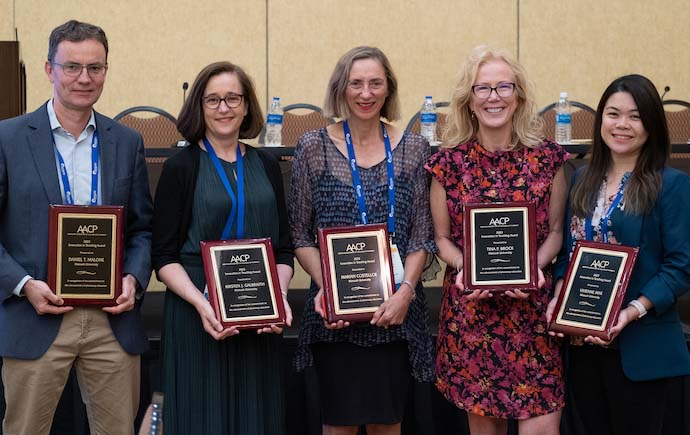 L-R: Dr Dan Malone, Professor Kirsten Galbraith, Marian Costelloe, Professor Tina Brock, Dr Vivienne Mak