Burke Honours Projects
Dr Richard Burke
Ion Transport and Metabolism Research Group
richard.burke@monash.edu
Projects
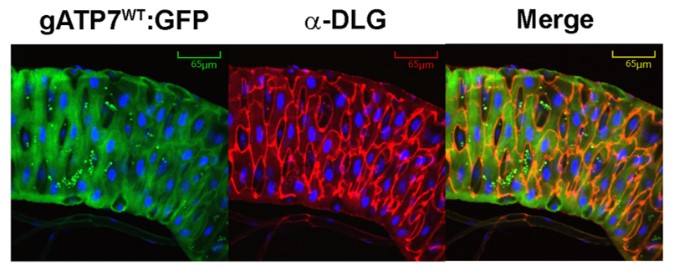
Regulation of copper transport and homeostasis Background: Copper is an essential yet toxic micronutrient required as a co-factor for numerous vital enzymes. Mutation of the human ATP7A gene results in the lethal, untreatable X-linked disorder Menkes disease. Together with collaborators at the Florey Institute, we have also found members of the Ubiquitin Proteasome System (UPS) that bind and mediate cellular responses to copper. We now wish to identify which UPS genes modify copper import and export activity, with the aim of finding novel targets for therapeutic intervention in Menkes disease. Project Aim: Techniques: Targeted gene knockdown and overexpression in various Drosophila tissues; in vivo genetic interaction experiments; examination of gene expression patterns and protein localisation in various Drosophila tissues by conventional and confocal fluorescence microscopy; mosaic analysis to examine the phenotypic effects of lethal loss-of-function alleles; molecular cloning and generation of transgenic Drosophila strains; proteomic analysis of ubiquitinated proteins in vivo.
***** Animal model of progressive neurodegeneration Background: Loss of a key E2 ubiquitin conjugase gene in the Drosophila eye has minimal impact on eye development but results in a progressive neurodegenerative phenotype as the adult fly ages. This phenotype is typical of Drosophila models of human neurodegenerative diseases such as Huntingtons, Motor Neurone Disease and Alzheimers. We hypothesise that loss of this ubiquitin conjugase leads to pathogenic protein accumulation, eventually resulting in cell death. Project Aims: Techniques: Targeted gene knockdown and overexpression in various Drosophila tissues; in vivo genetic interaction experiments; examination of gene expression patterns and protein localisation in various Drosophila tissues by conventional and confocal fluorescence microscopy; mosaic analysis to examine the phenotypic effects of lethal loss-of-function alleles; molecular cloning and generation of transgenic Drosophila strains; proteomic analysis of ubiquitinated proteins in vivo. ***** Maintenance of glial cell function by copper homeostasis Background: Copper is well-characterised as a micronutrient essential for neuronal health and development. We have now found that maintaining appropriate copper levels is also needed for the proper function of glia (or astrocytes), the cells that play numerous critical support roles in the central nervous system. This raises the possibility that copper’s known role in human neurodegenerative diseases may extend to glial function. Project Aims: Techniques: Targeted gene knockdown and overexpression in various Drosophila tissues; in vivo genetic interaction experiments; examination of gene expression patterns and protein localisation in various Drosophila tissues by conventional and confocal fluorescence microscopy; mosaic analysis to examine the phenotypic effects of lethal loss-of-function alleles; molecular cloning and generation of transgenic Drosophila strains; proteomic analysis of ubiquitinated proteins in vivo. |  |