Hall Honours Projects
A/Professor Matt Hall
Evolutionary Genetics Research Group
matthew.hall@monash.edu
Projects
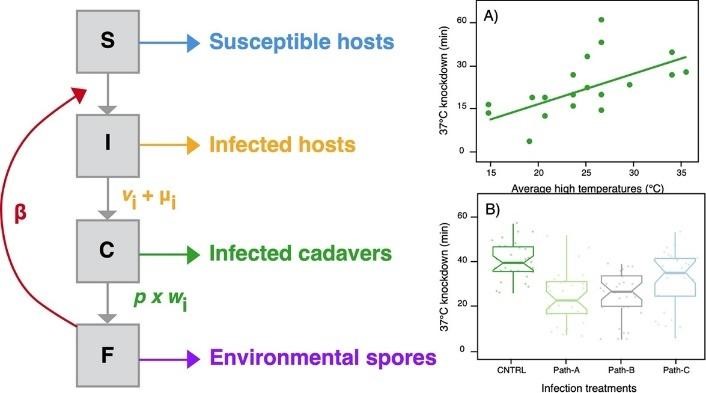
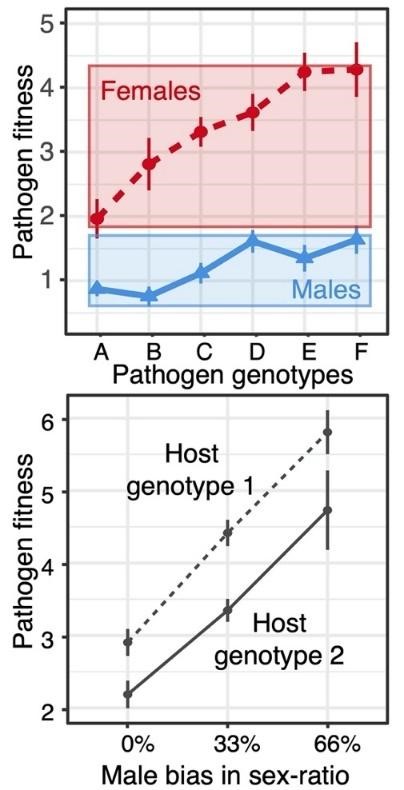
Sex differences and the evolution of infectious disease (various projects) Full time or Part time Background: Sex differences in the prevalence and severity of infection are universal. Across the animal kingdom, one sex is often described as the “sicker sex”, with females typically more susceptible to infection in invertebrates, whereas males suffer more in mammals and birds. Yet the science that guides our understanding of infectious disease routinely overlooks the pervading impact of sex. This gap begins at the very initial stages of research and discovery, when females are typically excluded from animal studies, or the sex of the subject is not explicitly modelled or controlled for in the published results. Using the model system of the water flea Daphnia magna, a variety of projects are available that explore how male-female differences can dampen or accelerate the spread and evolution of a pathogen. Project Aims: Possible aims include: i) Can males or female limit the spread of a pathogen by reducing a pathogen’s basic reproductive number (R0); ii) Does competition between pathogens occur differently in each sex and shape the maintenance of genetic variation in a pathogen population; and, iii) How does habitat quality influence the spread of disease and is a high quality habitat the same for each sex. Techniques: This project will utilise techniques including: epidemiological modelling, cross-infection experiments, animal handling and culturing, evolutionary genetics, and dietary manipulations. Students will learn how to wrangle, visualise, and analyse data using R. This project would suit to a student with an interest in ecology, animal behaviour and evolutionary biology, as well as health and disease. ***** Global change and host-pathogen interactions (various projects) Full time or Part time Background: Global change is predicted to result in a dramatic shift in the transmission and distributions of infectious disease. The combination of increasing temperatures and more prevalent outbreaks of disease has the potential to place species closer to the brink of extinction than previously thought. Key to predicting winners and losers under the nexus of infection and global change is any mismatch between hosts and pathogens in their thermal tolerances. Infection risk, for example, may well decrease if a host can thrive in conditions that are detrimental to the pathogen. Yet rarely are the thermal limits of hosts and pathogens considered in unison, hampering our ability to accurately forecast population declines under global change. Project Aims: Possible aims include: i) What host-pathogen traits are most susceptible to thermal stress and how does this influence the possible invasion of a pathogen as captured but its basic reproductive number (R0); ii) How does temperature influence the maintenance of genetic variation in a pathogen population; and, iii) Who is most susceptible to the combination of infection and thermal stress in a population – the old, young, male or female or other demographics. Techniques: This project will utilise techniques including: epidemiological modelling, cross-infection experiments, animal handling and culturing, evolutionary genetics, and thermal phenotyping assays. Students will learn how to wrangle, visualise, and analyse data using R. This project would suit to a student with an interest in ecology and evolutionary biology.
***** |   |