Mirth Honours Projects
Dr Christen Mirth
Developmental Responses to Environmental Change Research Group
christen.mirth@monash.edu
Projects
Developmental responses to environmental change Background: Changes in environmental conditions affect a wide range of developmental processes generating an impressive array of phenotypic variation. For example, the size of organs like the adult wing and ovary is determined by both nutrition and temperature experienced during larval development in the fruit fly Drosophila melanogaster. How these environmental conditions regulate organ growth has yet to be determined. Project Aims: This project will explore how nutrition and temperature modify the growth and patterning, the process by which cells acquire their identities, of developing organs. Using cutting-edge protein tagging tools that mark stages of organ development, we will rear larvae across thermal and nutritional conditions. We will then examine how these conditions affect the rates of growth and patterning in developing organs. This project could be adapted for either an honours or a PhD student. Techniques: This project will use transgenic fly lines with protein tags for the developing organs, immunocytochemistry, and advanced microscopy to visualise the growth and development of these tissues. Students will also gain expertise in fly husbandry and genetics, and some basic molecular biology. ***** The costs of coping with environmental stress Main Supervisor: Christen Mirth, Other Supervisors: Carla Sgro, Matt Piper Background: Our rapidly changing climate will expose organisms to changes in many environmental factors including changes in temperature extremes, humidity, the abundance and quality of food resources, and many others. For animals in the wild, this poses challenges because conditions that make them more resistant to one type of stress can worsen resistance to other stressors and can impact life history traits like fecundity and lifespan. For example, feeding Drosophila melanogaster fruit flies on a diet that lacks the amino acid isoleucine increases survival after cold shock but stops egg laying. In another fly species, D. serrata, populations adapted to colder environments also show reduced fecundity suggesting that adaptation to cold comes at a cost of producing fewer offspring. This project focusses on what underlies these trade-offs between stress resistance and life history traits like fecundity. Project Aims: This project will explore the mechanisms through which animals cope with extreme temperature. A key advantage is that this project can be adapted to either focus on the mechanisms and pathways that regulate cold tolerance or to identify the mechanisms through which locally-adapted populations differ in cold tolerance. Further, this project is suitable for either an honours or a PhD student. Techniques: This project will make use of populations of fly strains already maintained within the Mirth / Piper and Sgrò labs. Students will also gain expertise in fly husbandry, some basic molecular biology, fly genetics, methods for measuring life history and stress resistance traits, and statistical analysis.
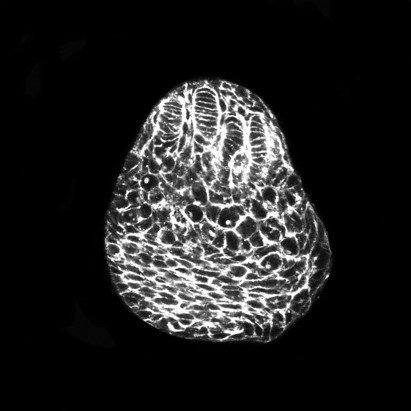
Developing ovary stained with phalloidin (actin cytoskeleton) ***** Growing up in a changing world: how does adaptation to novel environments affect larval tolerance to thermal and nutritional stress? Main Supervisor: Carla Sgro; Other Supervisors: Christen Mirth Background: Climate change will alter not only the thermal environment, but also the abundance and quality of many food resources for many organisms. While individuals within a population could all be exposed to the same stress, they often do not respond in the same way. This project focusses on the developmental mechanisms that underlie genetics variation in response to thermal and nutritional stress. Project Aims: This project will explore how individuals differ in their response to environmental stress in the fruit fly D. melanogaster. This project will make use of genetically distinct lines of flies that have been characterised to differ in their response to combinations of nutritional and thermal conditions. We will explore how the development of individual genotypes changes to alter these responses to stress. This project could be adapted for either an honours or a PhD student. Techniques: Through the course of this project, students will learn how to assay larval life history traits and to measure developmental progression across environmental conditions. Students will also gain expertise in fly husbandry and statistical analysis.
***** |   |