
Peters Projects
Professor Anne Peters
Behavioural and Evolutionary Ecology of Birds Research Group
anne.peters@monash.edu
Projects
Project offering: Honours/BIO3990 Project title: Using AI to quantify complex avian behaviours from large volumes of close-up nest video Background: Behavioural observations are key to understand how organisms rapidly respond to environmental changes and fluctuations. To minimise impact on observed subjects, we often use miniaturised video recording, which can rapidly generate many hours of recordings of complex behaviour. Recent advances in AI have enabled semi-automated data extraction, which – if successful – would be a game changer in our understanding of undisturbed behaviour in wild animals. Here we wish to test this a recently developed framework (BehaveAI) on complex behaviour by small individually colour-banded birds (purple-crowned fairy-wrens) provisioning nestlings at nests. The data consists of between 2 and 9 birds visiting nests up to 5-10 times per hour for 13 hours per day over 8-9 days, each delivering a range of prey types and sizes. Project Aims: This project will involve analysing videos previously obtained from nest cameras to quantify how offspring care (provisioning rates and prey size delivered) by individual birds varies with changes in temperature. Our research group has collected 100s of hours of video footage. We aim to optimise the video analysis framework BehaveAI to automatically extract contributons by (Troscianko et al (2026) BehaveAI enables rapid detection and classification of objects and behavior from motion. PLOS Biol 24:e3003632. https://doi.org/10.1371/journal.pbio.3003632) Techniques: video analysis, optimising AI algorithms, validation, statistical analysis, biological hypothesis testing. This project will involve analysing videos previously obtained from nest cameras to quantify offspring provisioning rates by individually colour-banded birds, so standard colour vision is needed. The project will involve moderate to advanced statistics in R (e.g., linear mixed-effects modelling). ***** Project offering: Honours/BIO3990 Project title: Thermoregulatory behaviours of nestling purple-crowned fairy-wrens Background: Resting metabolism in birds increases in hot conditions, including in nestlings. To maintain thermal homeostasis, nestlings can adjust behaviours that are important for thermoregulation. Behaviour is closely associated with thermoregulatory effort and can also indicate heat stress. Panting can increase respiratory air exchange, thereby facilitating heat dissipation but also results in water loss. However, it is unclear if panting is an effective strategy in hot and humid environments. If panting is ineffective, nestlings become restless—a clear behavioural sign of heat stress. This project will address how nestling panting frequency and restlessness change with nest temperature. Project Aims: This project examines how nestlings change their behaviours, such as begging and panting, in natural nests as it gets hotter. To investigate how nestling behaviour changes with experienced temperatures, we recorded nestling behaviour using close-up miniature cameras and in-nest temperatures recorded by micro-thermologgers placed on the nest roof and bottom of the nest cup. Recordings of nestling behaviour have been collected since 2025. The student will collect nestling behavioural data from the detailed video footage and integrate this with nest temperature records. Techniques: The work will involve watching close-up footage from natural nests of Endangered purple-crowned fairy-wrens. This footage is collected using body cams, and image quality is variable. The student will collect information on behaviours of nestlings (begging, panting) but also adults at the nest (size and type of provided, nestling care, and thermoregulation behaviour). Birds are individually colour-banded, so standard colour vision is needed. The project will involve moderate to advanced statistics in R (e.g., linear mixed-effects modelling), so enthusiasm for stats is beneficial. ***** Project offering: Honours/BIO3990 Project by negotiation Background: I will consider projects suggested by students in the areas of behavioural ecology, conservation ecology, climate change ecology and adaptation, telomere ecology. I prefer studies on birds, but other organisms will be considered. Check my webpage: https://petersresearchgroup.org
Project Aims: Dependent on project. Techniques: Will vary with project. |   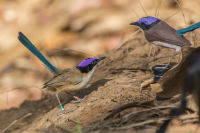 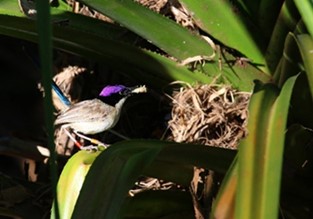 |