Sureshkumar Honours Projects
Dr Sridevi Sureshkumar
Genetics At The Core Research Group
sridevi.sureshkumar@monash.edu
Projects
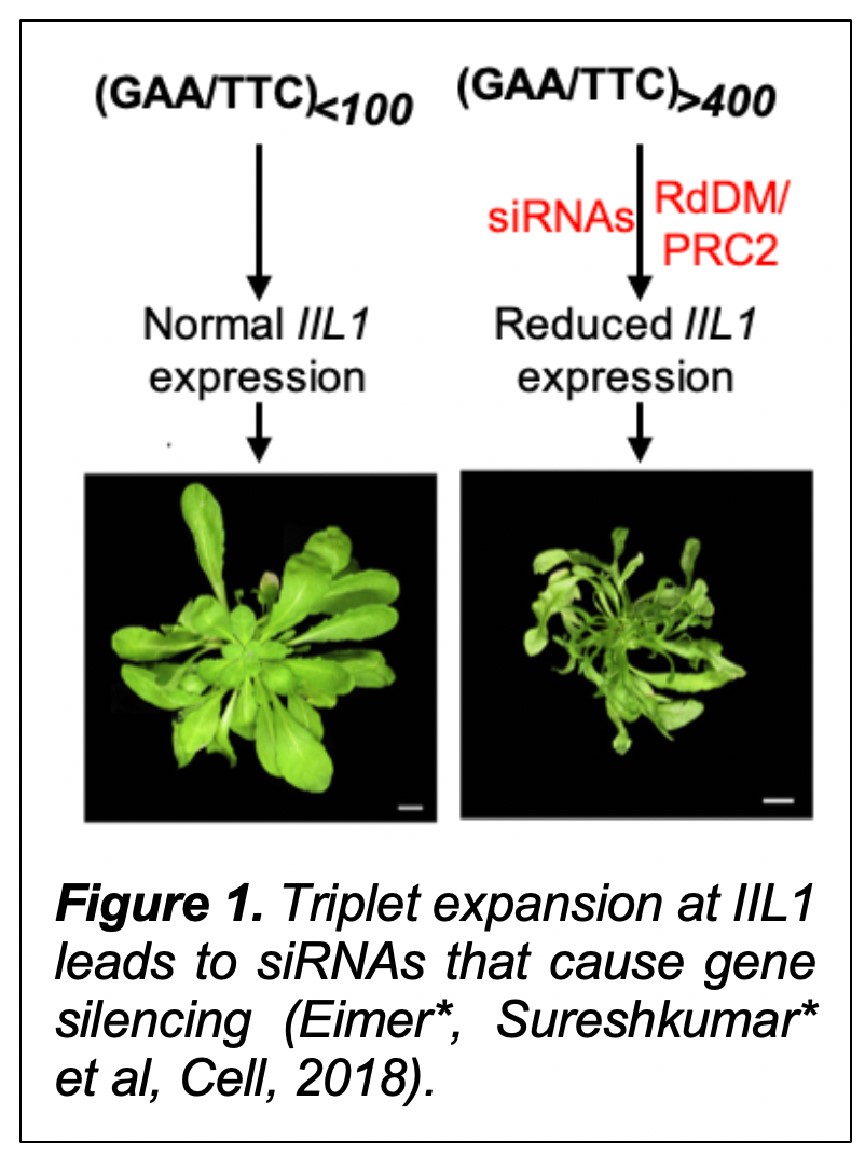
Mechanisms of triplet repeat expansions Full time Background: We have recently shown that intronic triplet repeat expansions trigger small RNA-mediated pathways causing gene silencing in model plant Arabidopsis thaliana. We have identified more than twelve components involved in gene silencing. Among the twelve components, six of them share the homology to human genes. More than 40 plus neuronal genetic disorders are known to cause by triplet repeat expansions. However, the underlying mechanisms are not known due to a lack of a model. Here we propose, Arabidopsis is a facile model to study intronic triplet repeat expansion mediated gene silencing. Technically amiable to manipulate the genes and feasible to perform large scale phenotypic screens within short periods. In this study, we will explore genetic screens to identify additional components involved in repeat mediated gene silencing. The identified potential genetic components will be tested in FRDA (Human triplet repeat genetic disorder) cell lines in the space of translation biology. Project Aims: Techniques: For this project we will use, SHORE map, Next gen sequencing, genetic crosses (complementation analysis), phenotypic analysis, PCR, RT PCR and qPCR. For pull down assays we will use CHIP and CHIP seq. To Measure the RNA and Protein levels we will use blot western and Northern blot to quantify the RNA (in addition to qPCR).
***** The association of regulatory RNAs in gene regulation Full time Background: The regulatory RNAs like siRNAs miRNAs, dsRNA, and long noncoding RNA, play a fundamental role in regulating gene expression. Recently we have shown that small interfering RNAs (siRNAs)regulates the triplet repeat mediated genetic loci in wild Arabidopsis wild strain Bur-0, identified in Ireland. More than 40 plus neuronal genetic disorders are affected by triplet repeat expansions associated with gene silencing, or protein toxicity leads to potential pathogenicity. Although the molecular pathogenicity is not well understood due to a lack of models. We mapped the phenotype to IIL1 locus harbored a long GAA triplet repeat expansion in the intron, quite parallels to the human triplet repeat disorder FRDA triplet repeat expansions occurred in the first intron of FXN gene. Subsequently, discoveries from our lab show that RNA polymerase PolIV and POLV regulate the gene silencing through RNA I machinery. At this point, it is ambiguous to know which substrate is for the small RNA formation in triplet repeat loci. The molecular analysis indicates that POLIV and POLV activity are required for gene silencing but by which molecular signals remain elusive? We think unusual structures over the repeat regions may play a role in increasing double-stranded RNA (dsRNA) or antisense RNA at IIL1 Locus. This could result in IIL1 mRNA degradation achieved through siRNAs. To understand the phenomenon, we would screen the activity of dsRNA or antisense RNA in Bur-0 and suppressors at the RNA level. The existing signatures like triplet repeats and downstream signals like change in chromatin marks are reliable indicators to explore R loop formation at IIL1 locus. R loop is a special chromatin structure contains both single-strand DNA and RNA molecule in hybrid form. Thus, we will examine R loop formation at IIL1 locus and the subsequent role in gene regulation. Project Aims: Techniques: PCR, RT PCR and qPCR,CHIP , CHIP seq and DRIP sequencing. To Measure the RNA and Protein levels we will use blot western, Northern blot, and qPCR. Model organism: Arabidopsis thaliana. ***** |  |