
Critical Minerals
Our Research
Critical Minerals, and in particular, Rare Earth Elements, are critical to energy transition and entwined in geopolitical security. Rare earth elements (REEs) are an essential group of metals that play a foundational role in the production of clean energy technologies such as wind turbines, electric vehicles and solar panels. REEs have unique magnetic and chemical properties which make them essential components of permanent magnets, batteries and other high-tech applications. With increasing global demand, variable geopolitics and the importance of social and environmental licence, Australia’s access to REEs is not assured despite the existence of deposits within our own borders.
We have the combination of people together with a network of collaborators - and through our integrated approach we have the expertise across the disciplines needed to find, develop and remediate clay hosted REE deposits. Our capabilities include:
Earth Sciences
- Basement characterisation including geological interpretation and modelling of aeromagnetic data
- Geological source region, ore deposit genesis and new deposit modelling
- Mineralogy & hydrothermal fluid chemistry
- Characterisation & innovative methodologies
- Regolith geochemistry including clay deposits
- Low and high temperature processing, metallurgy & hydrometallurgy including the influence of microbiota
- Remediation and the interactions between soils, sediments and water

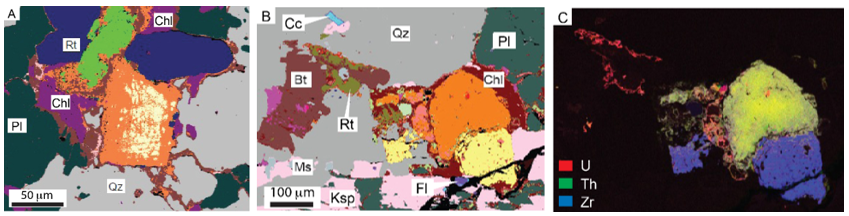
Mineral maps collected by electron microprobe showing the effects of metamictisation on the mobility of Rare Earth Elements, U and Th in graninitic source rocks (McGloin et al., 2015)
Monash University is involved in the Critical Minerals Consortium which seeks to better understand minerals criticality, global supply chains and provide advice for policy makers.
For further information, please contact Deputy Head of School Andy.Tomkins@monash.edu