
Teaching in Early Childhood Education - D60011
Professional entry master's degree
22 October 2026, online
Get an overview of the courses and answers to your questions about entry requirements, course structure, placements and more.
Save your spot
Find out more here
Breaking down this degree
This course will prepare you to teach infants and children (birth–5 years of age) in childcare, kindergartens and preschools, and is designed to meet the priorities and needs of modern teaching. Through studying contemporary ideas, practices and policies, you’ll build the skills and knowledge to become a research-driven leader with the ability to bring out the best in young people from a diversity of backgrounds.
Led by some of the brightest educators in Australia, you’ll have opportunities to turn theory into practice with professional work experience in urban, rural and global locations such as China, Italy and Switzerland.
What you’ll be learning
You will actively engage with contemporary theories, concepts and practices of early childhood education, developing inclusive practices to meet children's diverse needs and building a repertoire of strategies to manage children's learning and to support children's transition to school.
You will learn how to design, implement and engage young children in meaningful learning that will foster their creative, physical, personal, intellectual and social capabilities.
You will develop a deep understanding of the social and cultural contexts of early childhood provision for children, develop skills to work with families and communities, and learn to identify the range of local and international early childhood services available to practitioners.
Look ahead to an exciting career
With such high demand for excellent teachers, this degree opens up a range of exciting opportunities. It’s also a fantastic launching pad for careers beyond the classroom, in areas like government and private enterprise.
About registration and accreditation
Here’s what you need to know:
- Our degrees in early childhood education are accredited by the Australian Children’s Education and Care Quality Authority (ACECQA). This means you can work in licensed preschools and childcare centres in Victoria, and your qualifications are accepted in most other Australian states and territories
- You must be registered with the Victorian Institute of Teaching (VIT) to teach in Victoria. This includes schools and early childhood services.
- Check in with local teacher regulatory bodies about any extra requirements – whether you’re planning to work here or overseas.
At a glance
Course Details
Location |
|
|---|---|
Duration |
Full time: 2 years or 1.5 years accelerated. The Master of Teaching in Secondary Education is available in an accelerated 1.5 calendar years mode that includes a summer session (November to February). |
Start date |
Semester 1 (February) |
Qualification |
Master of Teaching in Early Childhood Education |
Why study with Monash Education?
Rankings
Study with Australia's #1 ranked Faculty of Education and one of the world's
top education providers, recognised for excellence in teaching and research.
Placements
Gain valuable real-world experience through professional placements that put
you in the classroom early, helping you build confidence and graduate
career-ready.
Student Support
Receive one-on-one support from a dedicated Education Success Advisor, helping you navigate every aspect of your university experience.
Chat to a friendly course advisor
Book a one-on-one call with our course advisor to answer any questions you may have about studying at Monash Education.
Teaching brings me joy
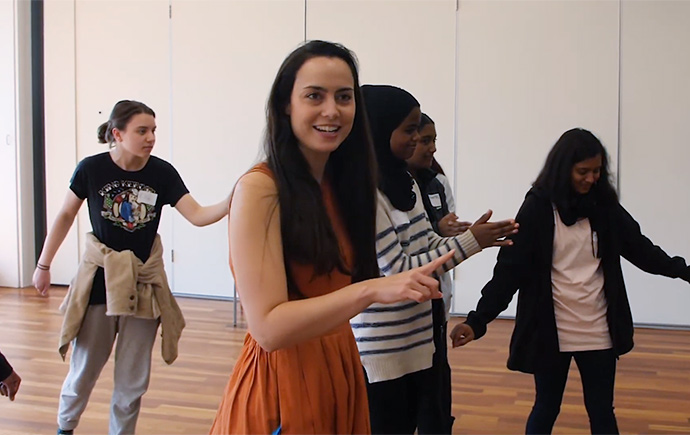
Emily Davison is an actor and now pre-service drama teacher who sees drama as a way of creating more empathy in the world. Her passion is infectious.
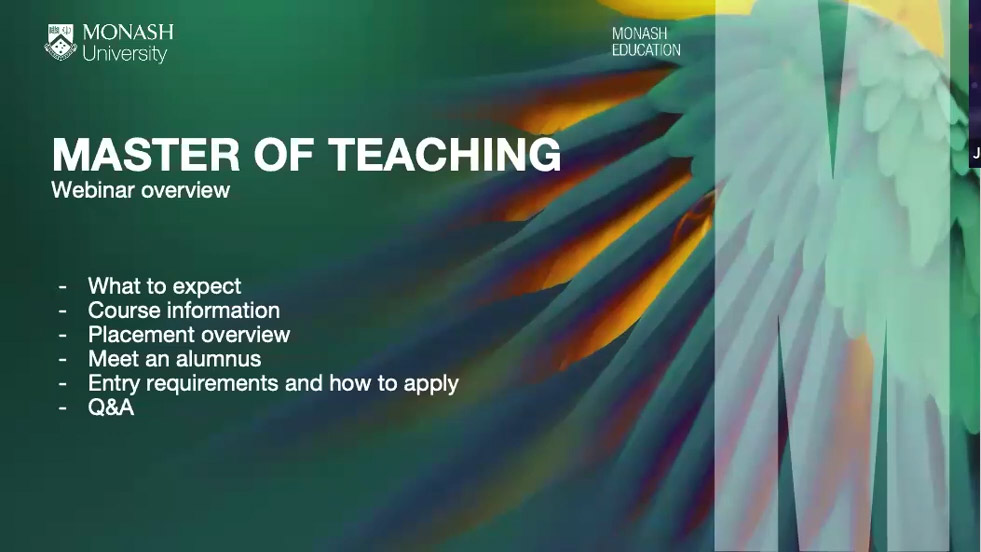
Master of Teaching Webinar
Thinking about a change? Find out more about the Master of Teaching at Monash and what a career in teaching has to offer.
Entry Requirements
You need to satisfy the following entrance requirements to be considered for entry to this course.
Minimum Entry Requirements (Domestic students)
Qualifications
An Australian bachelor degree (or equivalent) with at least a credit (60%) average. Admission into the course is competitive and may require a higher overall average than the minimum requirement.
Students applying for the dual-sector Master of Early Childhood and Primary Education must have at least one year of full-time equivalent study relevant to one or more learning areas of the primary school curriculum.
Students applying for the Master of Primary Education must have at least one year of full-time equivalent study relevant to one or more learning areas of the primary school curriculum.
Students applying for the Master of Primary and Secondary Education must have at least one year of full-time equivalent study relevant to one or more learning areas of the primary school curriculum and at least a major study* in one secondary teaching area.
Students applying for the Master of Secondary Education must have appropriate discipline studies to qualify for two teaching specialist areas or one double teaching specialist area with at least a major study* in one secondary teaching area and a second teaching area comprising at least a minor study^.
Available secondary teaching specialist areas can be viewed at the Faculty of Education website.
* Major study: equivalent to 6 units (36 credit points) of sequential discipline study over 3 years with no more than 2 units at level 1 and a minimum of 2 units at level 3.
^ Minor study: equivalent to 4 units (24 credit points) of sequential study over 2 years with no more than 2 units at level 1.
English requirements
Applicants must also meet the English language requirements.
University entrance requirements
Minimum entrance requirements for admission to Monash University Australia.
Extra Requirements
Compulsory: Extra requirements for application and admission
Situational Judgement test
Applicants must sit a Situational Judgement test to be eligible for entry into this course*. The Situational Judgement test is a requirement for many of the initial teacher education courses in Victoria. It is an online test designed to assess an applicant's personal and professional attributes. For more information on the test type options visit the faculty’s Situational Judgement test website.
* This requirement does not apply to applicants for the early childhood education specialisation.
Extra requirements for enrolment and graduation
National Literacy and Numeracy Test for Initial Teacher Education Students
You must achieve the standard in the National Literacy and Numeracy Test for Initial Teacher Education Students.*
You must:
- make your first attempt at completing the test by the time you have attempted 24 credit points of study; and
- achieve the test standard by the time you have attempted 48 credit points of study.
If you do not achieve the standard in both the literacy and numeracy components of the test within the stipulated time you are at serious risk of exclusion from the course.
This applies unless a different completion date has been determined in consultation with the faculty's Literacy and Numeracy Development Team.
* This requirement applies to students in all specialisations other than the Master of Teaching in Early Childhood Education.
Recognition of First Nations language proficiency by the relevant cultural authority or a formal qualification in an Australian First Nations language is an acceptable alternative standard. (Noting this alternative standard is in lieu of all LANTITE requirements).
Working with Children Check:
Before participating in a professional experience placement in any educational setting, students must meet specific security clearances that apply to the state or territory where the placement is being undertaken.
Immunisations:
Before participating in professional experience in an education setting you must meet immunisation requirements.
Professional experience expenses
You are responsible for any expenses incurred while undertaking professional experience (e.g. transport, equipment, immunisations, security checks and clearances).
Inherent requirements
To complete your degree, you will need to demonstrate that you have the abilities, knowledge, and skills to achieve specific core learning outcomes, these are called inherent requirements.
Find out more about inherent requirements for this course.
The course structure for the Master of Teaching can be viewed in the Handbook. You can
also view the course map.
Making the application
Future students
Course start date(s)
Semester 1 (February)
How to apply
Apply directly to Monash using relevant course code:
- Master of Teaching in Early Childhood Education - D60011
Current Monash students
You may apply to transfer from another Monash course. Transfers are a competitive process. You may apply mid-year for available courses however consideration will be given as to whether you will be able to follow your course progression.
Please note that if you apply for a course transfer, you should still enrol in your current course as if you were continuing so as not to jeopardise your enrolment in the Faculty if your transfer application is unsuccessful. More about Course Transfer.
Self assess for credit eligibility
Check for study credit using the "Credit search" link on the Credit for prior study page.
Fees
Fees are subject to change annually.
Commonwealth supported place (CSP)
The average annual student contribution amount for 2027 is:
A$4908
Note: see information on how fees are calculated.
Fee assistance
As a Commonwealth supported student, you may be able to either:
- pay all of your student contribution upfront, or
- defer payment through the HECS HELP loan scheme.
Fee information specific to this course
Domestic students in this course may apply for Austudy payments from Centrelink / the Department of Human Services. See the Austudy site for details.
*Additional eligibility criteria apply.
Full fee
Fees are per 48 credit points which represents a standard full-time course load for a year. The fees for 2027 are:
A$31,940