
Engineering and Science - E3007
Engineering involves the application of science. Many engineers are fascinated by scientific investigation and eager to enhance their understanding of the pure sciences. Likewise many scientists wish to see their theories applied towards new technologies.
If either of these describe you, then this double degree is ideal.
Starting with nine engineering specialisations, you can select from over twenty areas of science. The result is an educational experience uniquely tailored to meet your interests and aspirations. The various combinations offer diversity, flexibility and numerous career choices.
This course leads to two separate degrees. Depending upon your specialisation, you will be awarded one of:
- the Bachelor of Aerospace Engineering (Honours), or
- the Bachelor of Chemical Engineering (Honours), or
- the Bachelor of Civil Engineering (Honours), or
- the Bachelor of Electrical and Computer Systems Engineering (Honours), or
- the Bachelor of Environmental Engineering (Honours), or
- the Bachelor of Materials Engineering (Honours), or
- the Bachelor of Mechatronics Engineering (Honours), or
- the Bachelor of Mechanical Engineering (Honours), or
- the Bachelor of Software Engineering (Honours),
and also
- the Bachelor of Science.
You will gain all the benefits of each degree course (see Bachelor of Engineering (Honours)/Bachelor of Science) and be fully equipped to pursue a career in either or both in combination.
The first year provides the scientific and design foundations for engineering. It focuses on real life problems to help you understand the interaction between engineering and society. It also introduces the range of engineering disciplines. You then pursue your specialist engineering discipline from year two.
The combinations of engineering and science fields are almost limitless. You might combine environmental engineering with atmospheric science, ecology and conservation biology, genetics, plant sciences, zoology, chemistry, computational science, geographical science or statistics.
You might augment your aerospace degree with studies in physics or astrophysics, pair mechanical engineering with applied mathematics, or combine chemical engineering with geosciences. The choice is yours.
This course requires students to complete a total of 420 hours of continuous professional development, in order to graduate. This professional development may be in the form of 12 weeks of relevant vacation employment or an equivalent combination of approved professional development and/or engineering employment, taken throughout the duration of the course. Students are required to submit a series of reflections on their experience, with particular reference to development of each of the key Engineers Australia Stage 1 competencies.
At a glance
Course Details
Location |
|
|---|---|
Duration |
|
Start date |
Semester one (February), Semester two (July) |
View details specific to degree:
Please select a specialisation for more details:
- Anatomy and developmental biology
- Applied mathematics
- Astrophysics
- Biochemistry
- Chemistry
- Climate and atmospheric science
- Computational science
- Ecology and conservation biology
- Environmental earth science
- Environmental science
- Financial and insurance mathematics
- Geographical science
- Geoscience
- Human pathology
- Immunology
- Mathematical statistics
- Mathematics
- Microbiology
- Molecular biology
- Pharmacology
- Physics
- Physiology
- Plant sciences
- Psychology
- Pure mathematics
- Zoology

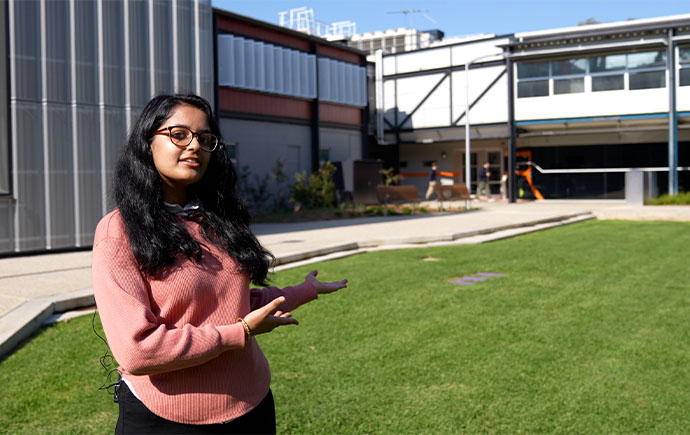
“I am passionate about space exploration and engineering is the closest I can get to working with cutting-edge technology to pioneer new ways to discover the universe.”
Sheffin Joju, Aerospace Engineering (Hons) and Bachelor of Science

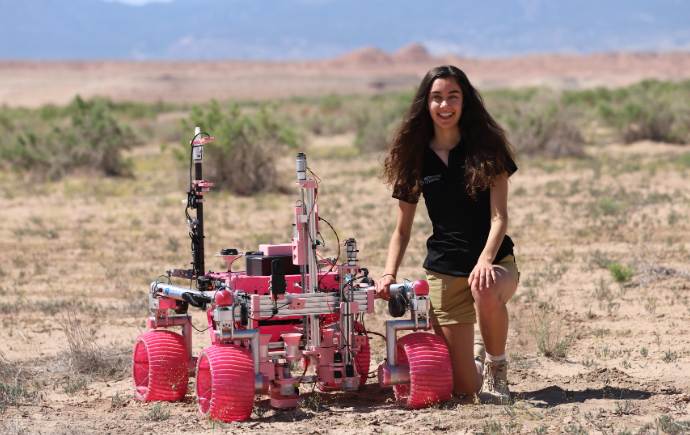
Georgia Jaffray, Bachelor of Science and Bachelor of Engineering, recipient of Monash Scholarship for Excellence.

"Within a Monash undergraduate degree you get quite a breadth of information which gives you a bigger appreciation of the big picture and how everything slots in together." - Tessa Charles Bachelor of Science / Bachelor of Engineering, PhD

“Science definitely taught me how to think critically and then how to be able to summarise information in a way that’s understandable by other people.” - Andrew Chiu Graduate, Bachelor of Science / Bachelor of Engineering – Analyst, Deloitte
Become a fully-qualified and accredited engineer in four years and play a vital role in solving the world's greatest challenges. Learn about our specialisations, double degree options, our Co-operative Education Program and our world-leading student teams.
Entry Requirements
Entry Requirements (International students)
You need to satisfy all of the following requirements to be considered for entry into this course.
At the time of enrolment in a course at Monash University, you must be at least 17 years of age.
All Monash undergraduate courses require you to have successfully completed a minimum of an Australian Year 12 qualification (or equivalent) and achieve the required academic entry score. Most Monash faculties generally use your most recent studies for admission however other guidelines may apply where your prior qualification may be considered.
Entry requirements for each qualification level are as follows:
All Monash undergraduate courses require you to satisfy English entry requirements in one of the following ways:
If your English test does not meet the above scores you may want to consider Monash English. Some Monash courses however do not accept Monash English.
The English measures outlined above must be completed within 3 years prior to the Monash course commencement date (other time limitations may apply as outlined in the Admission to Coursework Courses and Units Procedure). If you have completed several measures of English proficiency over a period of time, the highest valid measure will be accepted.
Monash University reserve the right to ask students to complete an English test to meet English course requirements upon request.
Further information can be located at English language requirements.
International students applying for a visa need to satisfy English requirements set by the Department of Home Affairs where these requirements and acceptable English tests differ from Monash University.
All Monash University undergraduate courses require you to have previously studied and achieved required Australian level standards in specific subject known as prerequisite subjects.
You must satisfy the following prerequisite subject requirements for this course:
*If you have completed an Australian Year 12 qualification you will be required to meet the prerequisite subject requirements that are equivalent to the VCE prerequisite subject requirements specified above.
You must satisfy the following additional requirements for this course:
Selection requirements
Extra requirements
Other
Inherent requirements
To complete your degree, you will need to demonstrate that you have the abilities, knowledge, and skills to achieve specific core learning outcomes, these are called inherent requirements.
Find out more about inherent requirements for this course.
Courses with maths and science prerequisite subjects
If the course you are applying for requires maths and/or science as prerequisite subjects, you can meet the requirements in the following ways:
- Australian Year 12 or International Baccalaureate (IB) Diploma Programme:
You must meet the maths and/or science prerequisite subject required for your chosen course as specified above (if applicable).
- Other qualifications recognised by Monash:
If you have completed maths and/or science subjects in the relevant discipline at the required grade level, it is assumed that you have knowledge equivalent to the Australian Year 12 (VCE equivalent) prerequisite subject required for your chosen course. It is strongly recommended that you check that you have covered the assumed knowledge required for your course by completing the Assumed Knowledge Skills Analysis.
This online activity includes multiple-choice questions based on your prior studies and helps you identify areas for revision, so you can start your course feeling confident and prepared. Once you accept your Monash offer and set up your student account you can complete the Assumed Knowledge Skills Analysis before starting your course.
These guidelines do not apply to the Bachelor of Medical Science or Doctor of Medicine, or to courses that require a tertiary-level Physiology unit: Bachelor of Pharmacy (Honours) (Graduate Entry), and Bachelor of Pharmacy (Honours) and Master of Pharmacy (Graduate Entry).
Alternative pathways
If you don't satisfy the requirements for direct entry consider these pathway options.
Entry requirements for Monash University are subject to change.
Making the application
Future students
Semester one (February)
Students currently studying an Australian Year 12 or the International Baccalaureate in Australia, should apply online through VTAC etc.
All other applicants apply directly to Monash using course code E3007
Semester two (July)
Apply directly to Monash using course code E3007
Current Monash students
You may apply to transfer from another Monash course. Transfers are a competitive process. You may apply mid-year for available courses however consideration will be given as to whether you will be able to follow your course progression.
Please note that if you apply for a course transfer, you should still enrol in your current course as if you were continuing so as not to jeopardise your enrolment in the Faculty if your transfer application is unsuccessful. More about Course Transfer.
Self assess for credit eligibility
Check for study credit using the "Credit search" link on the Credit for prior study page.
Fees
Fees are subject to change annually.
International fee
Fees are per 48 credit points which represents a standard full-time course load for a year. The fees for 2027 are:
A$63,040
Scholarships
We offer over 360 types of scholarships, valued at up to $280,000. Some scholarships offer one-off payments while others continue for the length of your course. Learn more about Monash Scholarships.
Other fees
The Student Services and Amenities Fee applies to some students each calendar year.
Enrolment Obligations
International students enrolling in a CRICOS-registered course can study no more than one third (33%) of their course by distance and/or online learning. Students must enrol in at least one unit that is not by distance and/or online in each compulsory study period unless the student is completing the last unit of their course. See standard 8.19 and 8.20 of National Code of Practice for Providers of Education and Training to Overseas Students 2018.
CRICOS code: 017107E








International course guides
If you are an international student and wish to find out more about our courses, entry requirements, studying at Monash and more, please download our international course guides below.
International Study Grants
