Embedding SDGs with creative storytelling
About this example
Dr Poovarasi Balan, Monash University Education Fellow and Senior Fellow in Higher Education Academy (U.K.). She is also leading the Education for Sustainable Development (ESD) Learning Circle. Under this role, she has developed professional academic training and teaching resources for participants on how they can integrate Sustainable Development Goals (SDGs) in their classroom using creative teaching techniques and pedagogies in a multidisciplinary context.
Faculty of Engineering (Monash Malaysia)
-
Sustainable Development Goals (SDGs) were given more emphasis in most accreditation exercises, especially with new requirements in 2025 for Engineering.
So with the latest accreditation requirement, many engineering academics had issues connecting SDGs and their specific targets in their curriculum. SDGs are extremely comprehensive in nature, and it is our responsibility as an educator to increase the awareness of the undergraduate students on its relevance before they enter the workforce so that they can include socially, environmentally and economically responsible decisions in their workplaces.
-
I teach third and fourth year students of Chemical Engineering background. In 2019, I was also teaching a shared civil engineering unit (ENE3608 Environmental Impact Assessment and Management) that was not a core Chemical Engineering unit, so it was challenging because students didn't want to come for the classes regularly, given their other final year design project commitment. I wanted to do something different to encourage the students to come to the classes and take my assignments seriously with every class attendance. My approach was to use creative assessment design such as comics, creative video making and mind maps to deliver the technical content in a simplified and engaging manner.

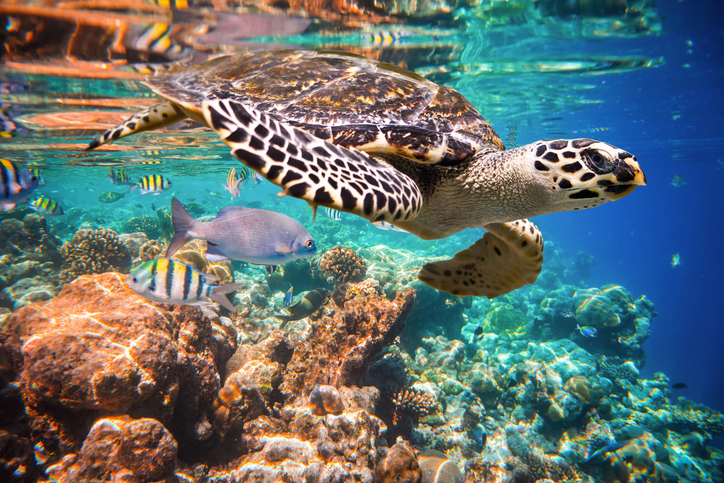
At that time, I was reading about environmental issues in Malaysia and I got emotional about a story related to the land reclamation issue, of female Hawksbill turtles not having enough nesting spots and going through extinction. They are classified as critically endangered species and their migratory patterns around straits of Melaka, Peninsular Malaysia are disrupted by climate change and coastal development.
So, I wanted to bring this story to the students as part of my assignment. As engineering is highly technical, the students or even the leaders can easily think that anything different (i.e. comics) or less technical can be seen as inferior. So after reaching out to campus Education Designer, I mapped the new assignment with Engineering Graduate attributes, unit Learning Outcomes and Chemical Engineering Program Outcomes, found in accreditation requirements to make it highly relevant to engineering context. Creativity also lies in connecting different and distinct dots, regarded high in Bloom's Taxonomy.
Though some students were puzzled by the introduction of comics in class, most students came to the classes more often to colour and draw. It wasn't a skill that any one of those engineering courses had, it wasn't a required skill to draw. In 2019, we didn't have AI, so students made everything from scratch with my weekly guidance and consultation over a month. We worked on story boards, environmental engineering concepts and changed the narrative to be more focused on problem solving, which is the central skill of engineering education. I monitored everything diligently to maintain our engineering tone and voice to communicate with businessmen, policy makers and the larger community. I wanted to bridge the gap between academic assignments and community engagement.
-
Since then, I have innovated engineering education through creative integration of sustainable development goals (SDGs) in all my classes in various creative forms and formats. I collaborated with the Non-Government Organisation (NGO), known as Malaysian Nature Society to secure a grant, and they collaborated with me to develop worksheets for the primary and secondary school audience. We delivered online training to Malaysian School Teachers in 2020 from 13 different states in the midst of pandemic chaos. The teachers then used those materials in their classes.
This, alongside the examples of student assignments, led to the birth of the website.
EcoEpic website
Visit websiteThe website has resources which can be used in schools or NGOs, such as comics, short videos created by undergraduate students and worksheets.
The website has close to 2 million views by 2025 and the engagement analytics actually shows that it has a significant global audience from the US, European countries, Singapore, outside of Malaysia, as well as a huge number of downloads for some of the resources, which I believe are being used in primary or the secondary school level. Given its global imprint, our case study was also published on the UN Sustainable Development Solutions. I have also recently published about SDGs in higher education institutions (HEIs) in the age of AI and Big Data, in a very highly reputable Journal of Sustainable Development (both linked in the supporting resources section below).
Given its impact, I also secured an international monetary grant under Monash Warwick Alliance in 2022 to continue working on different projects, known as “Sustainability Futurist” social media campaigns involving other youth from Higher Education Institutes around the country. The initiative uses citizen science principles where we deliver engineering concepts in a simplified way to common people for continued inspiration towards engineering solutions using UN SDGs.
I was also recognised for my teaching innovation as an Education Fellow of Monash University, Malaysia in 2024. Currently, I have an Education for Sustainable Development (ESD) Learning Circle under this role with 13 staff members from multidisciplinary backgrounds and 4 student members, which builds the partnership between academics and the next generation of young leaders.
As an Education Fellow, I train other academics from multidisciplinary backgrounds on how SDGs can be integrated into their classrooms in a creative manner using comics, clay models, role play and mind maps; we integrate story telling in all of them. We have trained close to 80 staff from academic industry from within and outside the campus, from both private and public universities since 2024 up to 2026 through two different training programs. As an accredited HRD corporate trainer, I have designed an approved course under myDevelopment course platform at Monash University Malaysia and the course is considered for 2 CPD points for their yearly training requirement. Our training program has received positive and encouraging feedback from past attendees from within and outside Monash.
Some of the training participants, who are now our sub-group leaders have successfully used these techniques in their classrooms and for external community outreach programs in high schools, as the methods taught are quite playful and colourful while incorporating SDGs in an explicit manner.
And I also trained Malaysian school teachers from 13 different states. We had about 69 of them attend my training. That's another impact - to hear from university lecturers and school teachers on how they use these resources in their classrooms.
Try it out
This exemplar requires medium effort to implement.
Recommended resources and training:
- Learn more about the Education for Sustainable Development (ESD) Learning Circle
- Register for training: Unlocking Your Inner Child : University and Sustainable Education - What are the parallels?
- Watch past workshop recordings: Dr Poovasari Balan - Clay Model and Creative Mindmap Workshops for Academics and Community Outreach
- Reach out to Poovarasi.Balan@monash.edu for permission to reuse materials with proper acknowledgement.
-
Starting something completely new could be quite daunting for the staff, so I’ve made it easier by creating something useful to be shared with other academics, such as case studies and assignment design examples with rubrics, making it easy to make the first step.
When I run my learning circle, when I invite associate professors or professors or people with experience and leadership positions to my learning circles, my first mantra is to make things easy and accommodating for them.
I noticed this with my own colleagues, who are so busy with their research that anything related to teaching, or innovation takes a backseat, they feel is not really recognised as compared to the quantitative research outcomes. I've done the difficult part so that I can guide them along the way and make them believe it worth their time to pursue their passion for teaching.
In the workshop training, I actually cover more of my latest work, but I always show them the website, to show how it can actually build up into something bigger internationally, and how I got my teaching grants to run those projects and how it can lead into educational leadership gradually. In essence, everything can actually be simplified through these strategies to meet their promotional criteria or yearly KPIs, which is their primary concern but people are not sure where to start.
In my training itself, we do clay modelling workshops where I show them how to design assignments, how to use rubrics and use the clay as a tool, so that they know how to integrate SDGs in depth, not just at superficial level because the SDGs are so quite broad with 169 targets and mapping them could be quite meticulous.
For example, if it is engineering, we only know the engineering related SDGs. Usually the mapping comes with the level one SDGs, but in my workshop I cover how they can open up and really look into embedding level one, two and three using multidisciplinary thematics. I have demonstrated this is my recent publication using a scholarly approach, which was our novel and significant contribution to the advancement of the field of sustainable development related academic publishing.
The approaches covered are specific but very much appropriate for the Higher Education Institute, as well as how to connect different dots which are not connected, so it becomes truly multidisciplinary. I teach them how to use the tools (clay, mindmaps) to design different themes and contexts in a creative manner in my workshops, so that they can apply universally in either business, engineering, psychology or medical sciences.
-
Any new teaching innovation could be daunting and extremely exhausting at first. However, it also helps us to rejuvenate our teaching approaches and keep up with the shift in mindset of the next generation.
Our resources to implement these things are available and are crafted with absolute detail to attention and step by step approach, in order to facilitate ease of adaptation in the classrooms.
Join our learning circles or use these resources to keep creativity in teaching at the forefront.
Supporting resources
Here are some additional resources that you can browse to help you implement this teaching practice.