A simple table can be used to check that all assessment tasks are associated with a learning outcome. Using this method it is easy to identify which ULOs may be under- (or over-) represented within the assessment design. In the example (Figure 4), note that not all not all learning outcomes are assessed in every task, but each assessment aligns with at least one of the learning outcomes.
| Learning Outcome | Assessment task 1 | Assessment task 2 | Assessment task 3 |
|---|
|
1. ...
|
✔
| |
✔
|
|
2. ...
| |
✔
| |
|
3. ...
|
✔
| | |
|
4. ...
| | |
✔
|
Figure 4: Simple table mapping ULO and assessment alignment within one unit.
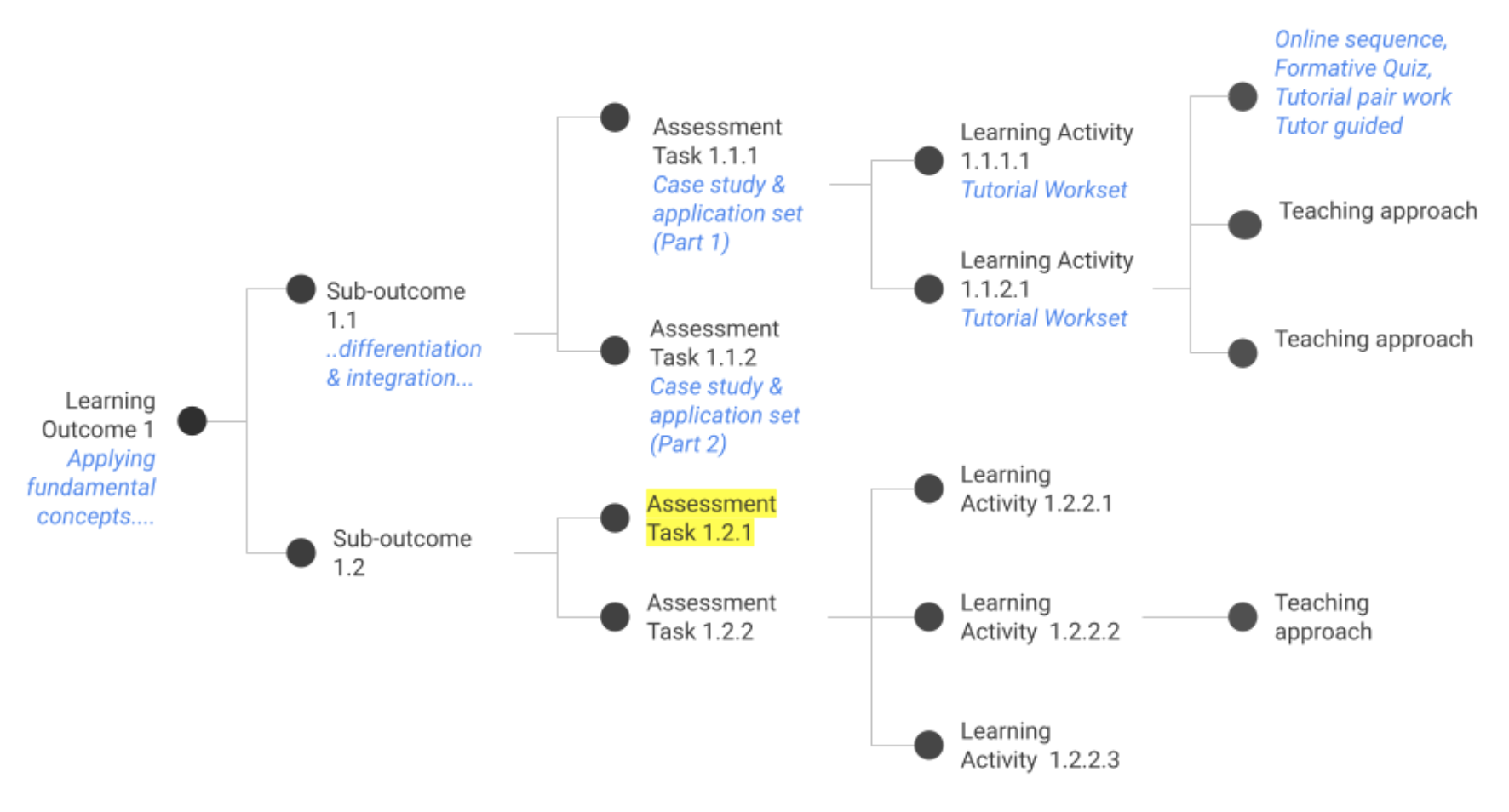
A more detailed table can be used to check the assessment regime includes a range of scaffolded assessment strategies to collect evidence of learning outcome achievement throughout the semester. A mix of diagnostic, formative and/or summative tasks for each ULO allows students to build and demonstrate their knowledge in a variety of ways.
| Learning Outcome | Evidence of achievement | Summative assessment (assessment of learning) | Formative assessment and scaffolding (assessment as learning) | Diagnostic assessment (assessment for learning) |
|---|
| 1. Apply fundamental concepts in calculus
| Correct application of X, Y, Z and choice of A and B to address problem set 1
| Week 5:
Case study and application problem set in class
| Weeks 1,2,3,4:
Weekly tutorial tasks (no mark) on core concepts with explanatory answer videos online and extension/ reinforcement activities. Weekly ‘drop in’ sessions with tutors. Forum with threads dedicated to certain concepts - sharing problems and helping peers. | Week 1:
Quiz on basic calculus using a Guttman chart to determine self-access learning
|
Figure 5: Detailed table mapping ULO and multiple assessment strategies within one unit.
A visual approach can display multiple units side-by-side to inform a programmatic approach to assessment design. In the MNHS example (Figure 5) four units are mapped. For each unit, the ULOs are listed alongside the assessment tasks that are scheduled for a 12 week or 6 week timeline. The assessment regime should consider the number, mode, sequencing, weighting and timing of assessment tasks and feedback. Using this visual approach it is easy to review the assessment load across the semester.

Figure 6: MNHS mapping ULOs and assessment across two units in a programmatic approach to assessment design. (View larger image)