
Complete Unit Health Checks
At a glance
Complete a Unit Health Check by working through the collaborative process between faculty leadership and unit teaching teams. Explore the tools and contacts involved, understand the faculty level actions, and follow the steps for completing an individual unit action plan.
Completing a Unit Health Check is a collaborative process between faculty leadership and unit teaching teams. The aim is to ensure improvements are practical, supported, and aligned with Monash’s commitment to high-quality student experience.
Unit Health Checks tools and processes
The primary tools for Unit Health Checks are:
- the individual Unit Action Plans (UIP, Unit Review, Unit Escalation documents),
- a Faculty memo for overall faculty responses, along with
- a spreadsheet for Faculty responses to High Fail rates.
The individual Unit documents contain records of past Action Plans. Please note that the design, triggers, and SETU itself has progressively improved and some past action plans may have data and details that don’t apply to the current process. The underlying actions and outcomes are still valid and should be taken into account in current Action Plans.
Unit Health Check contacts
SETU, HFU: Education Portfolio SETU and Review, pdvce-setu-review@monash.edu
Unit viability: Director Coursework Portfolio & Governance, Freya Troedel
Overall process
View

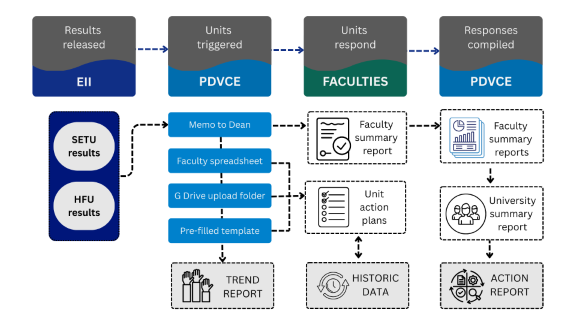
Faculty process
View
Faculty leadership plays a critical role in ensuring the Unit Health Check process is effective, supportive, and aligned with Monash’s commitment to improving student experience.
Faculty actions
Expand the accordions for detailed Faculty actions to complete the Unit Health Check process. Note: referenced files and templates are available from the Faculty Folder (Google Drive).
-
For units with a student experience “Very High”, acknowledge the success of the teaching staff as appropriate to your faculty. Encourage these academics to share strategies and become champions of best practice.
- A list of these units is in the Faculty folder (Google Drive File 3).
-
For units requiring an action plan response (both SETU and High Fail units), assign staff members to the roles required.
- A list of these units is in the Faculty folder (Google Drive File 3).
- All action plans are located in the Faculty folder (Google Drive Folder A)
- Determine staff for roles for each action memo (i.e., who will fill in the plan, who is responsible for implementing the actions). Different action plans will have more or fewer roles.
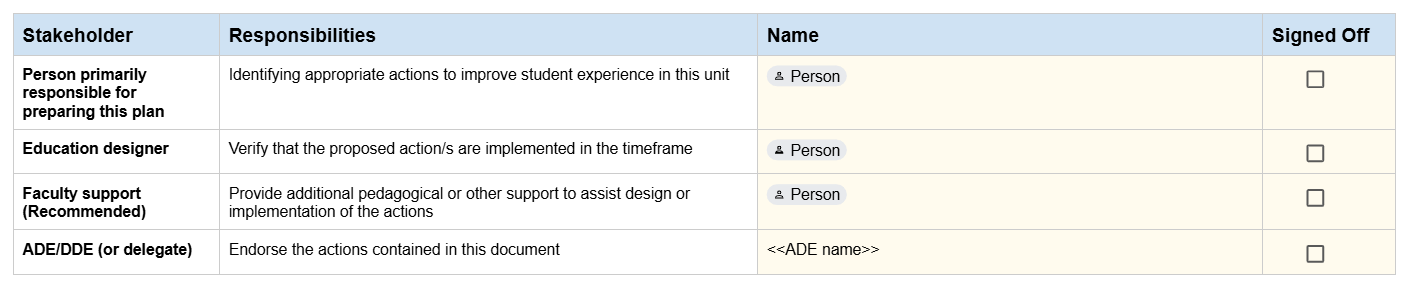
- Fill in the yellow area with the assigned staff to begin the Unit Health Check. As each role completes their responsibilities they may check off their task as being completed.
- Share the relevant Unit Improvement Plan or Unit Review memo with the staff and confirm deadlines for completion.
- Where appropriate, offer guidance and connect unit teams with educational designers or other support resources.
-
In the action plan for Unit Escalations choose one action of the three possible outcomes: a) continue teaching the unit, b) temporarily withdraw the unit, c) recommend disestablishing the unit.
- Provide a rationale for selection and future actions to be taken.
- If the unit will continue teaching, apply the actions described in the Distribute action plans step.
- Describe appropriate professional development or training requirements for academic staff, in addition to designing and implementing actions supporting improvements to the student experience.
- Meet with DVC(E) to discuss the outcome of the units that have reached the Escalation stage.
-
Units with low enrolment (<5 EFTSL UG or <2 EFTSL PG)
- A list of these units is in the Faculty folder (Google Drive File 3).
- Indicate future offering status using the use the drop-down options (Column J).
Theses options are explained in the Faculty SETU memo (Faculty folder Google Drive File 2), and defined here:
- Strategic to the Faculty: prestigious or notable units that provide benefits beyond the immediate student cohort
- Core unit: the unit delivers necessary skills or knowledge for an area of study
- Dual coded and above threshold: the unit delivery requires no additional resources, as it is dual- coded with a larger unit that meets viability thresholds
- Out of scope – research/professional experience:the nature of the unit restricts cohort size, or is out of scope for this process
- To be placed in teach out: the Faculty acknowledges that the unit is not currently viable
- To be disestablished: the Faculty will not offer the unit in future teaching periods
- Disestablished: the unit is disestablished in practice but has not been categorised as such in Callista.
-
As appropriate to your faculty, check in with unit teams during design of their action plans and offer educational design support where needed.
-
All completed action memos will be endorsed by the faculty ADE/DDE or delegate, indicated by a tick in the yellow area of the sign-off table.
-
Describe Faculty, School or Course-level interventions or improvements planned for implementation during the next 12 months.
- Faculty folder (Google Drive File 3).
-
Contact Education Portfolio SETU and Review pdvce-setu-review@monash.edu
- Share progress updates, extension requests, waiver requests, or questions.
- Notify when all documents are completed and endorsed.
Faculty folder (Google Drive)
The Google Drive faculty folder and toolkit has been designed to improve the unit quality process and allow easier SETU follow up.
Please relay questions, concerns, or suggestions for improvement to Education Portfolio SETU and Review pdvce-setu-review@monash.edu.
-
Item Title Purpose File 1 Advice for Faculty staff Please read carefully. File 2 SETU memo A reference copy of the memo sent to your Faculty Dean and Deputy/Associate Dean (Education). File 3 Units requiring action A spreadsheet containing three tabs:
- A list of units that scored ‘exceeding expectations’ for the teaching period (purple units)
- A list of units that triggered the requirements for review in the teaching period, and an indication as to whether the review required should follow the standard unit improvement plan, a full internal review, or an escalation to the ADE for consideration of future offerings
- A list of units with low enrolment counts. These require a response from the drop-down list in Column J, as well as any other information that the Faculty may deem pertinent.
File 2a Faculty Summary Report A Microsoft Word file of the Faculty Summary Report (Appendix 3 from your SETU memo, File 2) Folder A Unit improvement plans - current period A folder with pre-filled unit action plans for the current teaching period, based on triggered units in File 3b.
Unit process
View
Each unit action plan has two sections that need to be filled out by the reviewer, both highlighted with a yellow background. Once these sections are complete, there is a further yellow background tick box at the top of the document that can be used to indicate completion of the tasks.
Expand the accordions for detailed steps for completing a unit action plan.
-
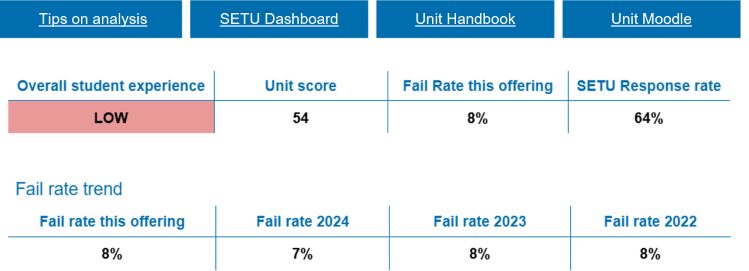
The staff member responsible for preparing the plan, reviews the data on student experience and possibly fail rates.
Consider the context of the student feedback and performance data provided SETU, informed by intelligence and guided by experience, collaborating as appropriate with educational designers and other support resources.
Links are provided to the SETU Dashboard, Unit handbook, and Unit Moodle page. Consider other data sources including:
- SETU dashboard
- Moodle surveys
- unit teaching staff
- formal and informal student feedback and
- any identified recurring themes or trends based on this and previous offerings.
-
Staff member responsible for preparing the plan provides a detailed analysis of the data with possible reasons for a medium or low student experience.
- Consider the context of the student feedback and performance data provided SETU, informed by intelligence and guided by experience, collaborating as appropriate with educational designers and other support resources.
- Enter the response in the yellow box.

Possible topics to consider in reflecting on student experience.
- Communication: including unit communication strategy for students and amongst the teaching team, via means such as Moodle, Zoom, in person and via email
- Equity, inclusion and support: including equitable access to resources, connection to and emphasis of support services such as PASS, SAS, and the Library
- Learning and teaching approach: including unit structure, engagement, teaching method, technical support and content load
- Staffing: including administration and unit management, educator attitudes and responsiveness, learning environment
- Assessment regime and design: including timing of assessment, weighting, assessment formats, and alignment of assessments to learning outcomes
- Marking and feedback: including feedback quality, manner and timeliness, related to assessment and related to learning
- Learning and teaching materials: including organisation and access to materials, quality and content of resources, access to recording and Moodle.
-
The staff member responsible for preparing the plan, designs suitable actions to improve the student experience.
- Planned actions are based on the analysis of the data and description of the underlying cause of a medium or low student experience response or high fail rate.
- Consult with faculty support and the verification staff member to ensure actions are realistic and aligned with unit goals.
- Links are also provided to resources to help design effective action plans.

Actions can be linked to one or more SETU mini scale surveys that can be used in conjunction with the action to verify the success or gain additional student data if the action fails to improve student experience outcomes.
- Communication: actions that increase or adjust the proactive distribution of information to students. This includes contacting students who miss submissions or perform badly, and increased communication through Moodle and email at key times of the teaching period. (TE2, TE10, TE11)
- Teaching approach: actions for improving communication, refining curriculum, building student-staff and student-student relationships, and creating a rich environment of learning (synchronous and asynchronous, in-person and online). (UE5, UE6, UE7, TE2, TE6, TE7, TE8, TE9, TE10, TE11)
- Inclusion and support (Sense of belonging): actions that promote and centre additional support services such as Student Academic Success, the Peer-Assisted Study Sessions (PASS) service, Peer Mentoring, the Mathematics Learning Centre, or the Disability Support Service. (TE4, TE9, TE10, TE11)
- Assessment design: intentions to restructure assessment regimes, relate assessments to the learning outcomes, and update assessment formats. (UE1, UE3, UE7, TE1)
- Marking and feedback: actions to provide increased or enhanced feedback to students, or to implement standardisation across teaching teams (e.g. through double marking). (UE2)
- Learning resources: improvements to the quality, quantity, or navigability of online resources across platforms such as Moodle. (UE4, TE3, TE8)
- Staffing: actions that specifically addressed the professional development of teaching staff, such as induction and orientation for sessional academics, teaching skills, and technical workshops.
Effective action plans
The proposed actions should be specifically targeted to resolve student experience issues.After the action is implemented the success can be further explored and verified through the use of the SETU mini scale surveys. These mini scale surveys are groups of questions related to specific domains, and serve as detailed information about the student experience in specific areas.
All proposed actions should also include appropriate mini scale implementation to gather additional student experience data. This is critical for cases where the action fails to improve student experience, to investigate further the underlying reasons for the reported student experience outcome.
-
Staff members responsible for preparing and verifying the plan are listed as stakeholders in the action plan document.
- Sign off the plan by clicking the checkbox next to the appropriate stakeholder.
- Submit the completed plan to your faculty by the deadline for ADE/DDE endorsement.
-
Staff members responsible for verifying the plan ensure the plan is implemented in the next offering.
Action plan example
This example action plan demonstrates how these ideas come together in practice. In this scenario, the review has identified that students feel disconnected from the relationship between lecture content and the assessment task, and are hesitant to seek help. In response, the reviewer has selected strategies focused on strengthening connection‑making and building a more visible and supportive online presence.
All proposed actions should also include appropriate mini scale survey implementation to gather additional student experience data. This is critical for cases where the action fails to improve student experience, to investigate further the underlying reasons for the reported student experience outcome.
Additional examples and resources
View
The following examples and resources illustrate how these shared principles can be translated into practical steps.
While every unit, location, and cohort brings its own distinct context, challenges, and student needs, the broader themes that shape effective teaching—and the pedagogical structures that support them—remain remarkably consistent. The specific actions taken within a unit may vary, but the underlying principles guiding those actions can be applied reliably across disciplines and delivery modes.
Importantly, all proposed actions should incorporate targeted mini‑scale surveys to capture additional student experience data. This ensures that, if an action does not lead to the expected improvement, there is sufficient insight to understand why and to refine the approach.
Expand each accordion for possible actions alongside relevant supports to assist with implementation.
-
Example actions that could be taken related to improve Teaching approach, specifically with alignment of learning outcomes, learning activities, materials and assessment:
- Align learning outcomes in the handbook with those visible to students in Moodle.
- Review the Learning Outcomes to ensure they are appropriate for the unit level and content.
- Review the Learning Outcomes to ensure they are appropriate for the unit level and content and include any necessary course outcomes.
- Map revised learning outcomes, revised assessment and learning activities and materials to ensure alignment.
- Make connections between theories, concepts, assessment and learning explicit in synchronous and asynchronous materials.
- Map learning outcomes, assessment, learning activities and materials to ensure alignment and appropriateness for diverse learner levels, including any necessary prior learning or prerequisites
- Communicate core and supplementary concepts and materials to students.
- Consider programmatic assessment for XXXX.
Useful resources and supports
-
Example actions that could be taken related to improve Assessment, specifically assessment design and communication:
- Conduct an assessment audit to check the purpose and focus of assessment tasks (including criteria) against learning outcomes and review through the lens of ‘necessary evidence’ rather than behavioural drivers.
- Ensure the associated workload is manageable and appropriate.
- Ensure redesigned tasks, criteria and weighting align with the learning outcomes and the associated workload is manageable and appropriate /and sufficient supporting information is available.
- Review and redesign clear task instructions and scaffolding activities for summative assessment tasks with clearly articulated levels of performance and standards.
- Ensure any “implicit” expectations are communicated clearly.
- Be specific about individual task requirements, rather than using a general category of assessment.
- Be specific about individual task requirements, and ensure that weighting is relevant to the workload and/or complexity of the task.
- Design summative assessment tasks (no more than 6) to integrate a number of different skills in a holistic manner, with clearly articulated levels of performance and standards. Avoid multiple sub-tasks.
Provide greater specificity in assessments, activities and materials through ‘sub-outcomes’ linked to the unit learning outcomes. - Provide rubrics and marking schemes, assessment deadlines and support in a timely manner and ensure all educators have the same information.
- Engage in peer review of tasks with colleagues.
- Conduct training and calibration exercises with teaching staff on the consistent application of the rubric.
- Prioritise assessable content and streamline or integrate tasks accordingly with clear instructions, expectations and criteria aligned with the learning outcomes.
- Where assessment relies on specific physical systems, design alternative experiences or tasks in case of disruption to campus.
- Provide information about expectations for assessment, such as sample questions with the marks that would be allocated for possible responses.
- Where assessment relies on external relationships, design alternative experiences or tasks as a contingency. Develop robust relationships with internal stakeholders to make industry connections more reliable.
- Create a forum on Moodle for student assessment queries.
Useful resources and supports
- How to choose the right assessment task
- Design assessment for academic integrity
- Supporting your students
- How to design and manage group assessment
- How to design and manage peer assessment
- Create groups and groupings in Moodle
- Related technologies
-
Example actions that could be taken related to improve Teaching approach, specifically learning and teaching activities:
- Align learning and teaching activities with revised learning outcomes and revised assessment.
- Clearly articulate which activities align with core requirements and outcomes and which are for extension or additional information.
- Reduce the volume of activities and content to align with revised outcomes and assessment structure.
- Make connections between theories, concepts, assessment and learning explicit in synchronous and asynchronous materials.
- Determine if learning activities are synchronous or asynchronous and design synchronous activities to facilitate cohort building, collaboration and communication.
- Increase the volume of synchronous and asynchronous activities to support consolidation and application of content and promote community
- Ensure scheduled learning and teaching activities take place regularly. If any are cancelled due to unforeseen circumstances, provide clear communication and alternative learning activities with equivalent student-educator or student-student engagement
- Ensure learning and teaching activities (in particular, scheduled sessions) do not exceed the allocated time.
Useful resources and supports
-
Example actions that could be taken related to improve Learning resources:
- Adopt a method to organise the content logically and hierarchically (e.g., Moodle Books) and clearly indicate relevance/importance (e.g., use of labels and embedding media) with appropriate sequencing and signposting (e.g., activities by week, not module).
- Curate existing materials and resources to audit alignment with outcomes and assessments. Provide clarity about core and additional resources through Moodle structure and labelling. Through the resources audit, determine if any areas have insufficient materials and support and develop materials accordingly.
- Adopt strategies to improve the quality and clarity of video resources.
- Regularly review materials such as the Practical Manual to ensure alignment with unit material and sequence.
- Regularly review materials to ensure alignment with unit material and sequence.
- Develop an online presence through the Moodle site signposting and forums.
- Update the Moodle site to include clear information about learning expectations and pathways, scaffolding within each week effectively/ structuring via week/module and scaffolding effectively/ using the Faculty Moodle template and navigation banner effectively.
- Update the Moodle site to include clear information about scheduled sessions and assessment task clarity.
- Ensure that information is updated regularly and only in one place to avoid multiple conflicting sources.
- Liaise with eSolutions and Monash Education Innovation to ensure appropriate and equitable access to software packages.
- Regularly review materials to ensure alignment with unit material and sequence.
Useful resources and supports
- Edit the unit format
- Create a learning pathway using labels
- Create a welcome page
- Create an assessment section
- Set up the Moodle Unit Preview
- Add a resource or activity
- Edit a resource or activity
- Restrict access to a resource or activity
- Track activity completion
- Create a Moodle assignment activity
- Set up marker allocation and marking workflow
- View the assignment grading overview
- Grade via the assignment grader interface
- Use PDF marking and annotation
- Grade using Moodle rubrics
- Grade using Moodle marking guides
- Enable anonymous submissions
- Set up extensions and resubmissions
-
Example actions that could be taken related to improve Assessment, specifically feedback:
- Implement feedback strategies in accordance with University feedback timelines.
- Provide templates and standards for the teaching team to provide consistent and high-quality feedback.
- Provide feedback templates to ensure consistency and efficacy amongst the teaching team.
- Implement strategies for timely educator-led feedback and adopt alternative and additional forms of feedback for students such as video, peer discussion, annotated exemplars and answer sets.
- Rationalise assessment regime to allow for educator-led feedback to be timely and balanced.
Useful resources and supports
- Use a
model for providing video feedbackConsider alternative ways of providing feedback (such as peer review).
-
Example actions that could be taken related to improve Communication and approach:
- Where multiple teaching staff are present, ensure consistency in communication with students through regular communication and meetings. Allocate one staff member for particular key aspects (e.g., assessment clarification).
- Work to build a cohesive, responsive and informed teaching team. Where multiple teaching staff are present, ensure consistency in communication with students through regular communication and meetings. Allocate one staff member for particular key aspects (e.g., assessment clarification).
- Build rapport with students in an explicit and intentional manner for online teaching and implement a student communication strategy across Moodle to support the cohesion across synchronous and asynchronous activities.
- Ensure consistency in communication with students through regular communication across platforms.
- Ensure regular and timely communication with students through announcements, scheduled and “drop in” sessions and scaffolding on the Moodle site.
- Build a positive and supportive presence through synchronous and asynchronous interactions, sharing your expertise and passion with students to make them feel valued.
Useful resources and supports
- Adopt a deliberate communication strategy for student engagement.
- Personalising learning in the online space.
- Maintaining an online teaching presence.
- Guide on Moodle Forums
-
Example actions that could be taken related to improve Staffing:
- Maintain professional and engaged interactions with students by considering the desired outcome of communications/ keeping the environment free from distractions
- Conduct regular team meetings with teaching staff to maintain consistency in approach and standards and alignment of content.
- Ensure that all teaching staff are suitably knowledgeable in the relevant unit content and task requirements or adopt team teaching arrangements to provide student support.
Useful resources and supports
How to ensure consistency and quality in marking