Programmatic approaches to assessment
At a glance
Explore why Monash is moving towards programmatic approaches to assessment and how this supports holistic, longitudinal views of student learning and the strategic integration of AI. Understand the guiding principles, benefits and real-world examples that can inform how you design assessment across a program.
Jump to these sections:
Monash is moving towards programmatic approaches to assessment. The aim is to support the integrity of assessment and student achievement while also facilitating a more holistic and developmental understanding of students' learning journeys. An important driver for this change is that, according to TEQSA’s guidance on assessment reform for the age of AI, programmatic approaches to assessment can help educators to strategically position use of AI within a suite of assessments and help identify where additional security is needed because students need to demonstrate learning without AI assistance.
Programmatic assessment supports a holistic view of assessment aimed at sampling diverse, authentic, and relevant evidence of student learning. A key element is a longitudinal focus on student learning and improvement. Rather than focusing on assessment at the level of a single unit, programmatic approaches focus on how different types of assessment and feedback together contribute to student learning across the curriculum. This holistic, longitudinal approach allows students to:
- Receive continuous feedback that enables them to recognise their achievements and adjust their approach as they progress through different units.
- Have multiple and varied opportunities to demonstrate their learning and develop their agency as learners accountable for their learning.
- Recognise that learning is about developing knowledge and capabilities rather than just passing assessments. Not be passed or failed on the basis of narrow or inequitable assessment tools.
Research (Schut et al., 2021; Heenan et al., 2021) indicates that programmatic assessment can have many benefits for students and educators, including:
- increased confidence in assessment decisions,
- reduced emotional burden and
- early identification of students who may require support.
While it will not be feasible for all Monash courses to achieve all aspects of programmatic assessment, the principles described below will be used as a framework to guide educators and course leaders as they reform assessment to integrate the use of AI. We use the term “programmatic approach to assessment” to capture the continuum of approaches in which assessment is considered from a program view while not necessarily achieving all of the principles below.
Principles of programmatic assessment
The following programmatic assessment principles are modified from Heeneman et al. 2021 to more clearly suit the Monash context and our diversity of programs. We have also grouped them into three guiding themes to make it easier to see how they interrelate.
When adopting a programmatic approach to assessment, we encourage you to consider which of the following are feasible for your program.
Theme 1 Continuous and meaningful feedback
View

Theme 2 Mix of assessment methods used holistically over time
View
Theme 3 Equitable and credible decision-making processes
View
Benefits of programmatic assessment
- Integration of assessment and learning:
Like any good assessment approach, PA aims to integrate assessment into the learning process, rather than treating it as a separate activity.
- Alignment with curriculum goals:
Learning outcomes must be designed to make sense across units and to be aligned with the overall curriculum objectives as expressed in the Handbook as Course Learning Outcomes (CLOs). This alignment helps to focus both teaching and learning on key competencies and skills that are coordinated within the wider program.
- Holistic view of student development:
By using a mix of different data-points that sample different forms of learning, PA provides a more comprehensive picture of student abilities and progress. This holistic approach aligns better with the complexities of contemporary contexts and disciplines. (Heeneman et al, 2021).
- Robust decision-making:
Progression decisions (evaluation of whether a student has demonstrated a course learning outcome) are based on multiple data-points collected over time, leading to more reliable and valid judgments (Heeneman et al, 2021) This approach reduces the impact of single poor performances on overall assessment and demonstration of learning outcomes.
- Promotion of self-regulated and lifelong learning:
PA can encourage students to take ownership of their learning process and build their feedback literacy. Through longitudinal dialogue, feedback and reflection that helps students make connections across units, students can develop skills in self-assessment and self-regulation. Skills developed through PA, such as seeking and using feedback, self-reflection, and continuous improvement, are valuable for lifelong professional development (van der Vleuten et al., 2012; Heeneman et al., 2021).
- Support students’ motivation to engage meaningfully with the tasks:
Making assessment tasks authentic, personally relevant and more readily applicable to real-world scenarios can support students' motivation to engage meaningfully with the tasks.
- Strategic integration of the use of AI technologies
The diversity of assessments enables strategic decisions about where students demonstrate individual skills and knowledge without assistance and where they can be demonstrated through collaborations with other intelligences (AI and/or peers). The holistic view affords the opportunity to build on students’ AI literacy across the course.
Examples of programmatic assessment in practice
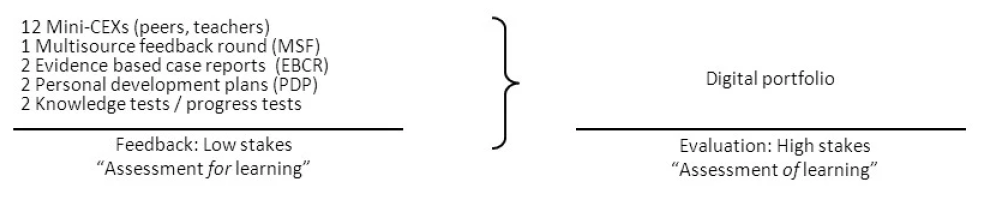
The following examples illustrate how the 12 principles of programmatic assessment have been applied in a higher education setting. Each example explains the approach, assessment regime and the final result as reported through the research. Please note that these are examples of application of many of the principles, which may exceed what is feasible, at least in the short term, in some courses.
PAAIR stories
Browse the PAAIR stories to learn how Monash educators are navigating their PAAIR journey in practice. Each story highlights real examples which explore approaches to programmatic assessment, integration of artificial intelligence, and more.