Trauma-informed practice acknowledges that traumatic experiences are highly prevalent. It is designed to support organisations to reduce risk of trauma and retraumatisation of people exposed to trauma. While trauma-informed approaches apply to a wide range of activities, the focus of these pages is on trauma-informed pedagogies in tertiary classrooms, and supporting tertiary educators to negotiate tensions in their units.
Prevalence: Davies et al. (2021) surveyed > 800 first year undergraduate students in an ethnically diverse part of England with a very high poverty rate. Four in five students reported at least one adverse event or circumstance before age 18, half reported three or more, and 20% reported at least six. Research from the US has similarly found that traumatic experiences are pervasive among college populations. According to one US study, 16.3% of 2,637 undergraduates surveyed reported multiple experiences of maltreatment (Berzenski & Yates, 2011). In Australia, it is estimated that between 50% and 67% of young people have experienced at least one traumatic event by the age of 16 (Bendall et al.. 2018).
What is “trauma”?
A commonly adopted definition states that trauma arises from “an event, series of events, or a set of circumstances an individual experiences as physically or emotionally harmful or threatening, which may have lasting adverse effects on the individual’s functioning and mental, physical, social, emotional, or spiritual well-being” (SAMHSA, 2014, p. 7). Using this definition, the term trauma is used to describe a reaction to an event that may be potentially traumatic.
It is important to recognise that trauma can be deeply subjective, and to respect differences in how an event is experienced by those impacted, including the perceived level of threat posed by the event. As the diagram below shows, traumatic events may be experienced by an individual, a generation, or an entire community or culture.
Levels of trauma experience
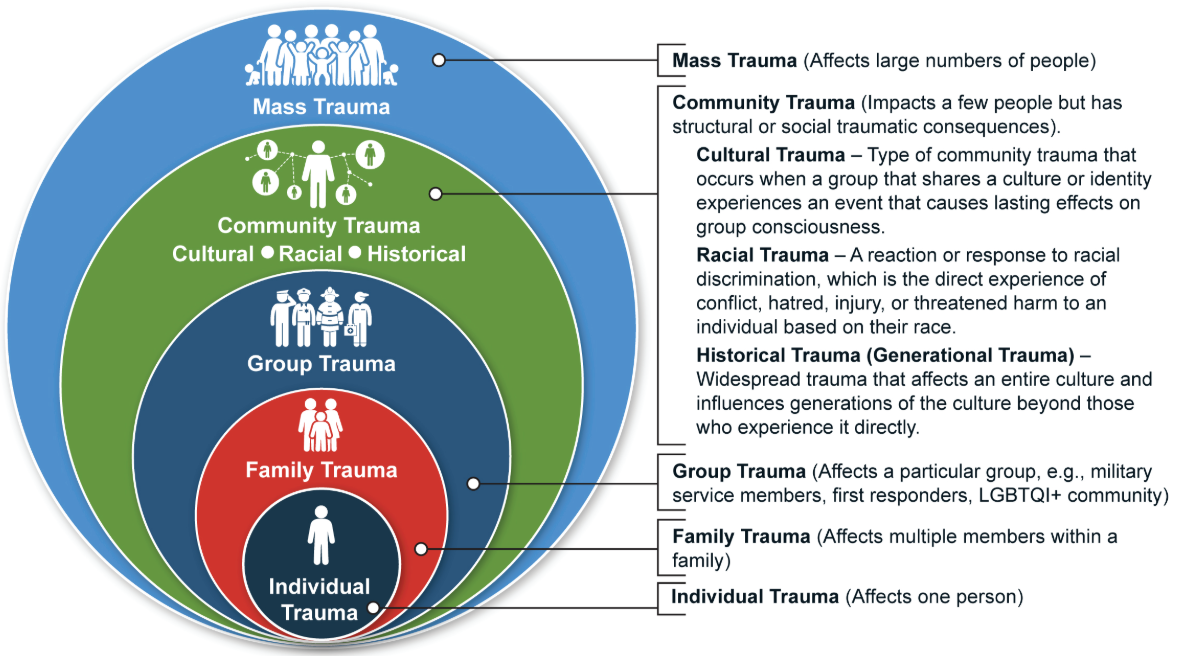
This public domain mage is from: Practical Guide for Implementing a Trauma-Informed Approach (samhsa.gov)
Examples of trauma include, but are not limited to:
- Childhood neglect
- Racial discrimination
- Poverty
- Homelessness or housing instability
- Experiencing or witnessing emotional, physical or sexual abuse
- Natural disaster
- Bereavement
- War
Past or current experiences of trauma may be associated with classroom conflict. Tertiary students (or educators) who have experienced previous trauma or are currently experiencing trauma may be more likely to experience a fear response upon encountering stressful stimuli or "triggers", even when these stimuli seem benign to others. For example, a student may be triggered by raised voices or increased tension in tertiary classrooms. Such a fear response may lead to escalation and interpersonal conflict and can negatively affect the learning experience of students.
Trauma-informed practice
In an education context, trauma-informed practice involves taking steps to reduce trauma and retraumatisation in learning and teaching, by creating safe, inclusive learning environments.
Trauma-informed practice refers to “a program, organisation, or system that … realises the widespread impact of trauma and understands potential paths for recovery; recognises the signs and symptoms of trauma in clients, families, staff, and others involved with the system; responds by fully integrating knowledge about trauma into policies, procedures, and practices, and seeks to actively resist re-traumatisation” of people exposed to trauma (SAMHSA, 2014, p. 9).
Retraumatisation (sometimes referred to as “triggering”) is re-living stress reactions experienced as a result of a current or previous traumatic experience, when faced with reminders of that event or a new traumatic event.
There are six key principles of trauma-informed practice (illustration adapted from SAMHSA, 2014). 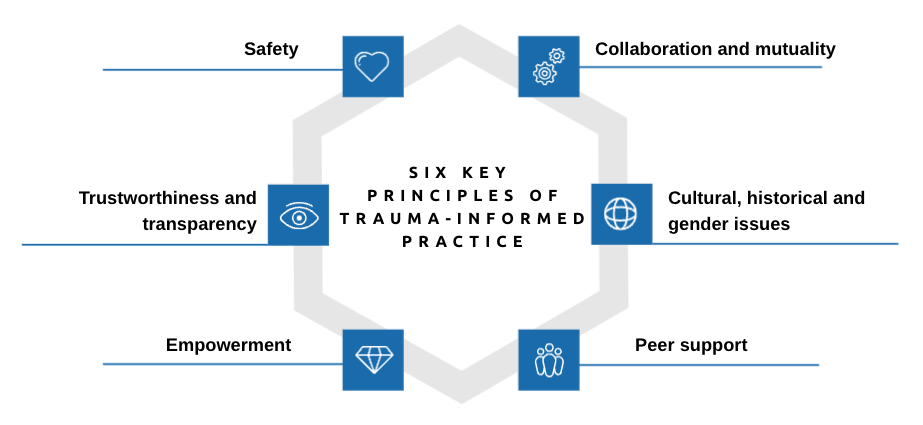
Adopting trauma-informed practice means having awareness of the impact of trauma on students and adopting approaches to maintain students' sense of safety, prevent re-traumatisation and promote recovery.
Trauma-informed practice in education
Trauma-informed practice provides educators with a framework to help them understand and respond to the impacts of trauma on students’ learning, emotions and behaviour. The aim of trauma-informed practice is to create a sense of safety in learning environments, thereby preventing retraumatisation and adverse responses to triggers in the classroom, including tension and conflict in the classroom.
Trauma-informed practice can also help educators to effectively manage secondary traumatic stress. Secondary traumatic stress refers to negative emotions and behaviours people may experience from knowing about another person’s traumatic experience, and stress resulting from helping or wanting to help that person.
Many other traumatic events may feature in classroom discussions, such as discussion of abuse, harassment, maltreatment, racism and global conflict. Use of trauma-informed practice can help educators to create safe, supportive learning environments that invite critical and respectful discussion and debate and promote intellectual challenge. They also create learning environments that recognise and are respectful of varied opinions, cultural traditions, religious symbols, dress, practices etc. These approaches can be deployed in circumstances where classroom tension and conflict arise, to help educators to effectively de-escalate classroom conflict and prevent re-traumatisation of students.
Implementing trauma-informed practices is essential, especially during periods of social tension and emotional distress. These approaches create a supportive environment that acknowledges the impact of trauma on learning and behaviour. Some practices that may be considered:
- Prioritise the learning environment as a space for enabling the demonstration of tolerance of difference, respectful dialogue and upholding academic freedom where all students enjoy the freedom to learn.
- Convey ideas in ways that would ensure that students and staff who hold and express different views would feel safe and included. Monash policy guides us to ensure that no staff or student should be subject to ‘threatening, or intimidating behaviour by another person or persons on account of anything they have said or proposed to say in exercising their freedom of speech’.
- Encourage diverse perspectives while maintaining an environment in which learners do not make assumptions. Facilitate constructive conversations by encouraging students to ask for clarification when they may not understand a point someone has made, or to not assume they know what others are thinking. Foster empathy and active listening skills among students.
- Provide sensitive content warnings when discussing topics within the classroom that might produce strong emotions.
- Offer opportunities for private discussions for students who may be personally affected by certain topics.
- Create opportunities for reflection and processing after discussing challenging topics.
- If any comments within classrooms cross the line and harm the safety and wellbeing of staff and students, it is important that the complaints process at Monash be utilised for reporting purposes. Students or staff can report concerning, threatening and inappropriate behaviour to the University’s Safer Community Unit, and Security is available on 03 9902 7777 for assistance on campus, or 03 9905 3333 for emergencies
Adopting trauma-informed practice in teaching and learning doesn’t require omitting or avoiding discussion of contentious or potentially-distressing issues. By implementing these strategies, educators can navigate sensitive subjects effectively, promoting intellectual growth while maintaining a supportive classroom environment.
Trauma-informed practice allows for the exploration of complex issues while anticipating and minimising the potential harmful impacts on all students' emotional well-being.

 Trauma-informed approaches
View
Trauma-informed approaches
View

 Prevent, manage and recover from conflict and tension escalation
View
Prevent, manage and recover from conflict and tension escalation
View