
Active learning
Active learning
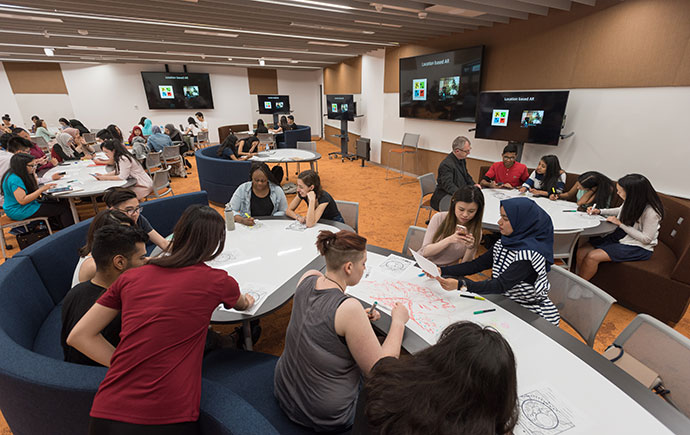
Active learning is an instructional practice that engages students to be active participants in their learning and provides opportunities for them to use higher order thinking skills such as analysis, synthesis and evaluation.
What are the benefits of active learning?
Active learning has been shown to increase students' involvement in their learning process, increase levels of engagement, improve students’ problem-solving abilities, metacognitive and reflective thinking, increase confidence and motivation to learn. Active learning requires students to engage at a higher level of cognition and understanding since they are thinking about what they are learning as they go. Rather than being passive consumers of knowledge, they are builders of knowledge too.
-
Prepare for active learning
Learn how to design activities for students to take an active approach to learning when planning your unit.
-
Employ Teaching Associates (TAs) effectively
Learn how to utilise teaching associates effectively to improve the student learning experience and learning outcomes in your classes.
-
Design active learning
Learn about different active learning strategies and task types you should consider when determining what will best capture your learning outcomes.
-
Facilitate active learning
Learn about strategies to consider when planning and facilitating active learning in synchronous small and large classes.
-
Engage students asynchronously
Learn how asynchronous activities can foster collaboration and engagement among your students and elicit a sense of community.
-
Design with the 4 A’s
Learn how to involve students as decision makers in their own learning based on Jane Vella’s 4 ‘A’s framework.
-
Teach using the DEAR model
Learn how the Faculty of Pharmacy and Pharmaceutical Sciences embedded the “DEAR” model of active learning across their curricula.
-
Teach for active learning in constrained spaces
Learn how to design for active learning in constrained spaces with thoughtful design and imaginative use of space as well as appropriate teaching approaches.
Supporting your students
View

How to support your students
Consider the following guidelines when delivering learning to students. The guidelines are a response to a major theme in research — the importance of the teaching and learning experience: students’ everyday interactions with the curriculum, staff and peers, and the learning environment.
1. Get to know your students
Take the time to get to your students and respect their diverse ways of learning, their challenges, circumstances and strengths. This can be done early on in the semester with opportunities throughout to engage with them.
- Use icebreaker activities to get to know them on a personal level.
- Personalise any feedback you provide on assessments.
- Reach out to students you feel are struggling or are absent from class on a regular basis.
- Share personal experiences and values.
- Get feedback from students at the end of a class on what they have learnt and how well they have learnt.
- Offer weekly ‘chat times’ where students can reach out to you for one-on-one chats.
- Use pictures of faculty and staff on the Moodle site and provide a bio of the teaching staff so students get to know you.
2. Implement principles of inclusive education and/or universal design in the curriculum.
Here are a few ways that you can support students to be more inclusive and incorporate accessibility into your activities.
- Use a range of teaching activities to accommodate a broad range of learning styles (videos, discussion, lectures, groups, guest speakers).
- Provide accessible formats to support screen readers or the audio impaired such as ALT text, video closed captions or transcripts, etc.
- Provide extra material or exercises for students who have knowledge or skill gaps.
- Use different assessment methods - written, oral, presentations, projects etc.
- Provide clear and personalised feedback on assessments in a timely manner.
3. Explain to students their role in active learning
Some students will come to your sessions more prepared than others to engage in Active Learning. Many students are used to taking a more passive approach to their education, and being met with the activities typical of a learner centred environment that require more interaction and deeper thinking can be uncomfortable.
You can assist your students by:
- informing them of the active approach you take in classes
- outlining your expectations of them, and
- providing examples of what participation in Active Learning looks like in your context.
Providing students with this information both before the unit begins and on an ongoing basis throughout the semester will equip them with the foundation to continually build upon their capacity for collaboration and higher order thinking, facilitating more active engagement in your subject.
4. Facilitate student interactions and connections.
Here are some ways that you can support student interactions:
- Ask students to share information about their backgrounds and interests.
- Ask students to present their work in class.
- Use technology such as online forums to encourage discussion.
- Use class time for students to work on projects.
- Get students to provide constructive feedback on each other's work.
- Create student study groups.
Understanding and estimating instructional and studying time
Introduction
Defining "class time" can be challenging, especially when adapting a course to alternative formats like hybrid or online. Effectively organising time to boost engagement and make the most of synchronous or in-person sessions in online or hybrid settings is a key consideration. Here we explore the connection between instructional time, homework, and credit hours, shedding light on Monash University's expectations and the Moodle platform. Additionally, we explore various instructional time options, some of which may deviate significantly from traditional classroom practices.
Instructional time
At Monash, studying four six-credit-point-units in a standard semester, students need to commit to around 48 hours of study each week. This may sound a lot, but it's similar to time spent by a typical Year 12 student doing five subjects with: three to four contact hours per week per unit/subject. The credit hours assigned to a course are determined by its weekly meeting hours or instructional time, which varies for capstones, internships, and other course types.
While traditional in-person teaching typically centres on classroom hours, online and hybrid learning can take various forms. This includes asynchronous activities like watching recorded workshops, Moodle quizzes, H5P Activities, discussion forums, and group activities adapted for virtual settings.
The key characteristic of instructional time lies in the interaction between instructors and students. Regular interaction implies frequent academic-student connections, while substantive interaction denotes academically oriented engagement initiated by the instructor.
In hybrid or online courses, instructional time encompasses the total hours students spend on synchronous activities and asynchronous equivalents, such as recorded workshops, Moodle quizzes, discussion forums, and collaborative projects.
NoteIn addition to instructional time, students should dedicate approximately twice the class time to preparation and out-of-class assignments each week, as what we describe as ‘study time’. This varies from person to person, student to student. |
Estimating the time students need to learn or perform an activity
The time students take to learn and respond can vary based on several factors, including the complexity of the material and the specific learning activities involved. Estimating the time required for students to learn or respond is somewhat subjective, but here are some general considerations:
-
More complex topics may require additional time for understanding and processing. Consider the depth of knowledge required and whether it involves new concepts or builds on existing knowledge.
-
Different activities demand varying time commitments. For example, reading an academic article might take less time than completing a case study or engaging in a group discussion. Interactive activities often require more time for thoughtful responses.
-
Tasks with clear instructions and straightforward objectives may take less time. Complex tasks, such as problem-solving or critical analysis, might require a more substantial time investment.
-
Students' prior knowledge of the subject can impact the time needed. Familiar topics may be processed more swiftly than entirely new ones.
NoteRemember, flexibility is key, and acknowledging the diverse learning paces of students contributes to a more inclusive learning environment. If feasible, seeking feedback from students about the time commitment for various activities can provide valuable insights for future course iterations. |
Planning online or hybrid instructional time equivalents
While instructional time in traditional classrooms is evident through physical interactions, online and hybrid situations demand a thoughtful mix of in-person and virtual interactions to calculate instructional time. Virtual instructional time can involve adaptations of in-person instruction or different activities to ensure engagement.
Various strategies for interactive and engaging instruction include recorded workshops, synchronous small group discussions, quizzes on Moodle, virtual field trips, and more. The focus should be on highly interactive options that facilitate student-academic and/or student-student engagement.
Estimating workloads
With a range of instructional strategies, it's crucial to estimate the time students spend on tasks. Asynchronous instructional time may involve more mental and organisational effort than some forms of classroom instruction. Consider that students may be working harder or spending more time than anticipated. Design prompts, assignments, and grading schemes with this in mind.
Estimated times for common virtual learning tasks include:
· Discussion posts: Minimum 30 minutes for a 250-word post and skimming other posts.
· Blog post: Approximately 30 minutes for a 250-word reflection post; longer posts may require at least an hour.
· Case study activities: Consider reading and writing time; times vary based on the complexity of the exercise.
· Independently arranged experiences: Include time for arrangement in addition to the experience itself.
· H5P Activities: Take your time to complete these on your own for a more accurate estimate. Some include reading, videos, and quizzes, while others are simpler.
NoteThese are estimations based on an average student's speed. |
You are encouraged to explore the following resources:
Resources and services available to students
Resource that teaches students how to get the most out of livestreaming during your online lectures, orientation, and information sessions. Know how to prepare, how to engage actively during the session, and how to consolidate and revise after the stream.
FLUX Participating in Activities
A short guide that explains how to participate in activities organised by instructors such as polls, Q&A sessions and others.
LearnHQ: Collaborate with others
This guide assists students with the process, leadership, and possible difficulties around group and team work.
Resource introducing students to the use of Zoom for a variety of online learning and teaching contexts at Monash University, from large-scale sessions, to small classes based on group work, as well as study group or teamwork collaboration meetings.
This Monash Library guide provides students with an overview of how to post, edit, and start a new discussion in a Moodle Forum. This is a great resource to help students familiarise themselves with the activity and its functionalities.
Student support: Learning online
This Student Support guide provides Monash students with information about studying online. They have resources on study support, specialist support, learning technologies, enrolments, units and timetables, resources to study successfully online.
Use Microsoft Teams for study groups
This resource will guide students to effectively use Microsoft Teams for online communication: create and manage teams, share screens, collaborate on whiteboards, participate in discussions and share files.
Related resources
View
-
Active blended and online learning
View this Monash Teach HQ resource for more information on blended, online and hybrid learning.
-
Using multimedia in your teaching
View this Monash Teach HQ resource for more information on ways that you can use multimedia to increase student engagement and collaboration.
-
Collaborative learning
View this Monash Teach HQ resource for more information on type of collaboration and strategies for implementing it in your classroom.
External resources
-
The asynchronous cookbook
The Pressbook has provided this open sourced book that has a plethora of great resources on asynchronous teaching and learning. Learn about group and teamwork in asynchronous settings, discussion activities, simulations and more.
-
Teaching channel videos
This site provides informative videos, tools, and information to get you started and support you in your teaching.
-
The neuroscience of active learning
This blog article published in the OpenLab at City Tech provides some valuable insight on a multisensory approach to learning and why a multisensory approach to learning is so important.
-
The TRACK framework explained
PowerSchool provides a great overview of the TRACK framework and how to incorporate it into the classroom.
-
Integrating technology with Bloom’s Taxonomy
Arizona State University has provided a great way to use Bloom’s taxonomy while integrating it with educational technologies to support learning.
-
Effective use of game-based elearning in higher education
eLearning Industry published this article on why you should use game-based learning in higher education while providing some key strategies for its integration.
-
Library of facilitation techniques
SessionLab has provided a variety of case studies on different facilitation techniques and activities that you can use in your teaching.
-
10 reasons students don’t participate in online discussions and how to remedy each
Debbie Morrison wrote this blog article in Online Learning Insights to share some useful strategies to dealing with students disengaging in an online classroom.
-
Engage your students in your online course: 20 proven ways
This article in TeachOnline.CA provides 20 strategies that you can use to increase engagement in your online unit.
Other university active learning resources
Education Performance Standards Framework
View
The Education Performance Standards identify the expectations of education practice at Monash – See the Education Performance Standards for more details.
Impact on student learning | Impact on educational knowledge | Impact on educational environment | |||||
Effective teaching and learning | Responsive program design | Student- centred orientation | Professional learning engagement | Pedagogical content knowledge | Education research performance | Education innovation | Education leadership |
✓ | ✓ | ✓ | ✓ | ||||
You could address these Practice Elements by providing evidence of how you:
- Demonstrated ability to use engaging, authentic and active approaches to teaching and learning.
- Demonstrated contributions to development of activities, units and courses using key active learning strategies.
- Demonstrated contributions to support positive student learning experiences in practice by creating a safe and active learning space.
- Demonstrated ability to create or adapt your teaching to include more active learning opportunities for students and solicit their feedback to improve your teaching and unit/course design.