Simulating Parent-Teacher interviews with GenAI
About this example
Associate Professor Joanne Blannin, course leader for the Master of Teaching program, sought to address the problem of how to bridge the gap between theory and practice.
ATLAS allowed students to transfer their learning and gave students a safe space to rehearse parent-teacher conversations with Generative AI personas with diverse social and cultural backgrounds in a low stakes environment.
Faculty of Education
-
One of the consistent challenges with teaching is that we have to somehow connect what students do on placement in a school as a pre-service or student teacher with the more theoretical studies they’re doing at university.
It's often hard to bridge those two things. In Education and initial teacher education, trainee teachers get the opportunity to teach in classrooms, go to staff meetings and interact with other teachers but it's quite rare to interact with parents of children because they're high stakes conversations. The qualified teachers will be having those conversations, so the problem we came across was “how do we prepare students that are new teachers to engage with the parents?”
We've had traditional role plays where student teachers take on the role of a parent and others take on the role of a teacher, but they always are a little bit lacking in realism and responsiveness.
So that's why we started building ATLAS.
-
What we've done with ATLAS is built personas that have diverse cultural backgrounds and diverse emotional and social responses to situations. We’ve tried to be culturally representative when setting up the avatars. I came up with 20 examples of parents and then I went out to schools to ask for feedback, for example:
- If these examples are realistic or not,
- Are they too stereotypical? Have I underrepresented or overrepresented socio-cultural groups?
- Have we been inclusive or exclusive?
- Do you have any other examples?
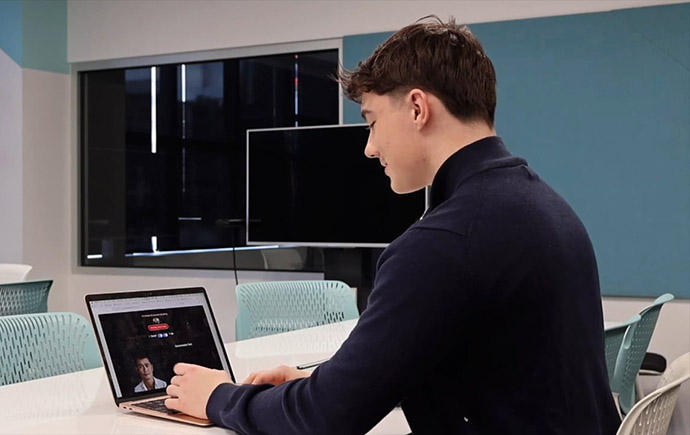
Then we allow our beginner or pre-service teachers to interact with those AI personas. Students have some instruction in how to access it and how to use it through synchronous training online. Then students had asynchronous access to the platform so that they could use it as they felt they needed. Students could experience having conversations with the AI as if they were talking to a parent. For example, talking with a parent about:
- Their child having some behavioural issues
- Their child doing extremely well in a particular area
- Their child needing some social supports
- Their child needing some additional testing for some other issues
- Their child achieved very highly and needs some extra support to extend their learning.
ATLAS is a safe space to rehearse those conversations where the risks are lower stakes and students can afford to get it wrong and try again.
Watch the video below for a short demonstration (45 seconds)
-
The outcomes have been really exciting. We've undertaken this across four different core units in the master of teaching. As a research project, we have undertaken pre and post data collection comparing:
- What student teachers feel about the experiences they have on placement
- Their learning and their engagement with parents and with external professionals
- How students feel after they've engaged with the ATLAS platform
-
80% of participants
Told us they're recommending ATLAS to their peers and classmates, which is really exciting because it tells us that they're seeing some really intrinsic value in the experience.
-
76% of students
Told us that they have already felt a transfer of the learning they have in ATLAS to the real world context.
The majority of students are telling us that they can actually see a transfer between the virtual ATLAS experience and the real world, so we're starting to actually bridge and close that gap so that's really exciting for us!
Some of the other things that students are telling us is that they would like ongoing access so that they can rehearse. It's not just a one and done, students want to go back in and try a different approach in a conversation because they thought they could have done better, or because it went really well but they were not quite sure why and want to go and practice doing well again.
It has been really exciting that our student teachers are taking self-motivated action to improve in a particular area that we had no real way of teaching or measuring before. We now have this unique online platform that they can engage with.
What we also found is an increased uptake before they go on placement, particularly for students who come from different backgrounds or for students who perhaps have come to teaching later in life. In the master of teaching, about 50% of our cohort are career changes so it might have been a while since they've been in a primary school or been in a secondary school or early childhood centre, and they're not quite sure what it's like or how to engage with parents. It’s changed over time or perhaps it's culturally distinct from where they grew up.
We're providing asynchronous access just before they go out on placement to schools, and we're seeing that more people are taking the opportunity to engage and just see what it's like to talk to parents about education and about the children and about the programs that are running and have that experience before they go on placement.
The outcomes are ongoing and we will continue to measure it.
What's Next
Now that we've established that the ATLAS tool is scalable and usable and that we've had positive feedback, in 2026, it will become part of the program for all students in the Bachelor of Teaching and the Master of Education so every student will have access to ATLAS to have some interactions, then to reflect on those interactions and do some metacognitive work around where they need to develop and what they need to upskill in or rehearse to unpack more for their own development.
Try it out
This exemplar requires medium effort to implement.
Recommended resources and training:
- Contact ATLAS.AI@monash.edu to work with the ATLAS team to create a specialised application for your educational use case.
-
I've worked with ATLAS across a number of fields and having worked across different faculties in helping others set up simulations, a few things that we've noticed is that a lot of people have ideas already because they already use case studies, scenarios or role plays.
Any kind of scenario based conversations, whether it's a law firm or an engineering meeting, or an art design brief discussion, we can take professional experiences that the academics already have in-depth understanding of and turn them into the AI-enabled interactive scenarios with ATLAS.
Students can benefit from the personalised experience because the AI will react to what the student says, and also you can bring in the criteria from your unit learning outcomes and also your course outcomes. For example, if you are trying to develop specific soft skills such as collaboration, empathy, listening skills, interactive language, specific content knowledge that your field requires.
So if you come to us with particular skills, particular experience or a particular emotional circumstance that you want the students to experience, then we can help you build the personas. You can then test it and come back to us and we can work together to modify all of that as we go through the testing process. For example,
- If the tone of their persona is not quite right (too formal or too informal)
- They're talking in too long sentences
- I need them to be more hesitant to talk
- I need them to give less/more information
- I need them to have an understanding of this concept, but not this concept.
We can work to work with you to scaffold the development of the avatar to meet those needs.
-
- Start with what you've already got. Have a look at the role plays you already do or the scenarios that you already embed in your program. So many of us already work to try and bridge that gap using scenarios and role play, that's probably where that work already sits. The other thing to think about is where the gap between theory and practice is.
- Consider what the key skills are crucial to your program, but are a little bit more challenging to teach, measure or evaluate. That's a really good place to start thinking about how ATLAS might be useful to you.
- Developing the personas can take a little bit of time, it's definitely a two-way back and forth conversation with the ATLAS team. We can help you build the experience you want your students to have, and it’s changeable as we go through the process.
Supporting resources
Here are some additional resources that you can browse to help you implement this assessment.