Students as partners
About this example
Students as partners (SaP) is a structure of teaching that is based on collaboration and constructivism. This provides a unique opportunity for pre-service teachers to interrogate curriculum and deliver teaching sessions.
Maria Gindidis is the chief examiner of two introductory units which provide an introduction to the teaching profession for all education students, and a core unit which is designed to be taken in conjunction with students’ final professional experience placement.
Faculty of Education
-
I had an ‘aha’ moment when moving around in a lecture theatre, taking the microphone to students: if I involved the students as partners, what depth could it bring into the core units and breadth across the whole course? I was also inspired by the iSap project and wanted to model that practice within the context of the Education faculty.
My journey in education has been incredibly diverse, from being an adviser to Ministers to a school Principal. By the time I became a teacher educator and academic, I wanted to push the boundaries and explore the preparation of future teachers and rethink current teaching paradigms. Education is a vocational field and I questioned how to push educational, professional, personal, vocation and skills-based “boundaries” with our pre-service teachers? Could we talk with students about curriculum and include them in the decision making of our unit content instead of talking about it and to them?
-
As chief examiner of mega first year (core) units and a large fourth year core unit, I chose this opportunity to partner with students at different levels to co-construct a teaching improvement cycle.
The project is entirely optional. I placed an announcement in Moodle inviting students to work with me on a unit topic and co-deliver a lecture. It was an aspirational endeavour offering students a chance with their peers to talk about unit assessment tasks and content. I held a number of meetings discussing and unpacking the content and ideas for presenting (teaching). We met on synchronously online and face to face, deciding on materials and resources, including my lecture slides from the previous year and using ideas from their own assessment tasks.
I started this activity by inviting students to be involved and exploring with them my own teaching session lesson plan. We began discussing aspects of teaching in physical spaces and the importance of non-verbal language and public speaking skills. I encouraged them to think about the transmissive theatre space and strategies to make teaching sessions more participatory.
We co-created and developed a lesson plan, similar to what is required for a classroom. We carefully structured every 10 minutes of the lecture. We interrogated the idea of different types of teaching that placed the audience at the core of what was happening. Students added and modified their teaching plan to deliver a teaching session that linked to the unit assessment tasks.
The discussions guided by students were documented. Through this process the following concerns and ideas emerged:
- What does the audience (students) expect to gain from a teaching session?
- What are the learning outcomes of a session and how do they link to the assessment tasks?
- What is public speaking?
- How do you use non-verbal cues?
- How can you make a transmissive teaching space more participatory?
- What are the differences between pedagogy and andragogy and how do these inform planning?
- What does it look like, sound like, feel like to teach to a large number of students?
Each of these questions were reflected on. These are skills that inform best practice in teaching and mirror what pre-service teachers think about before and during school placements and ultimately what they will reflect on and refine in their professional lives as future teachers.
-
Students felt connected, visible and heard! It has set a benchmark for what students are looking for in other units. It was an incredible experience for both myself and my students.
Students in this unit have redesigned what assessment tasks could be, the content and learning outcomes. Working together students are co-constructing and evaluating the improvement cycle for the following year.
It has lowered attrition in the first year units, improved connectivity, attendance in workshops and produced excellent SETU scores for a mega unit.
I was able to pilot mini case studies of the SaP project before, during and after the COVID19 pandemic. Each case study (currently writing for publication) involved the gathering of documents and materials concerning the unique SaP collaboration. Using phenomenology as a methodology, my mini case studies allowed me to attempt to capture the “lived experiences” of each student partner.

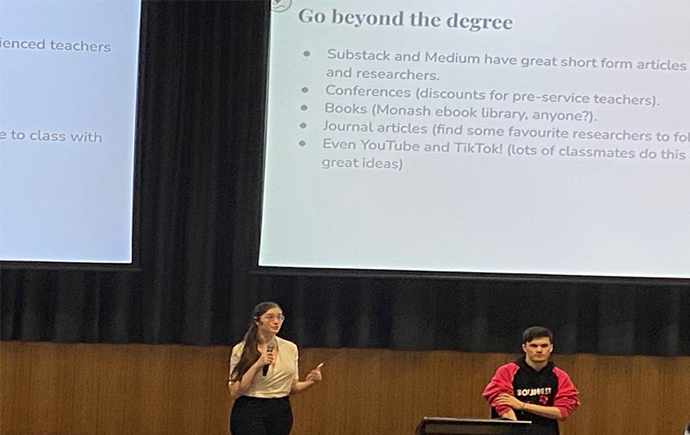
Photo: Second year students running a teaching session to first year students (G19 LTB, 2022)

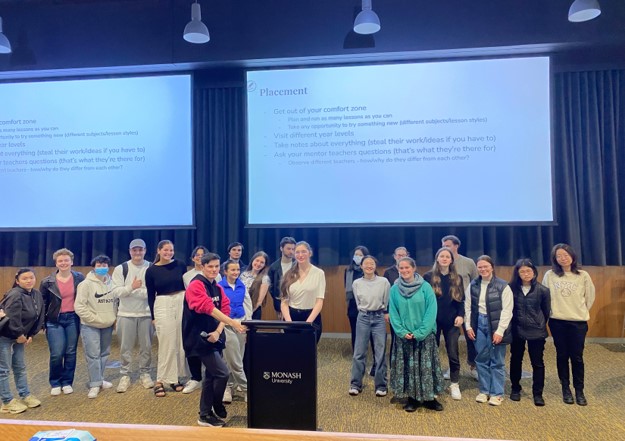
Photo: SaP Teams 2022
-
Connect
"You have to be able to connect with the students, in order to make them connect with the subject you are teaching." - 4th year student taking first year teaching session
-
Enjoyment
“I really enjoyed the experience and would love to do it again! I love the concept and it makes me think that I can enjoy teacher education.” - Student quote
-
The vibe
“Generally, when I’m presenting study skills seminars etc as part of my role at Edrolo, I don’t need cards and I can focus on being really present and connecting with the students, being engaging, feeling the vibe in the room and so forth. So I am pleased with the positive feedback but am keen to improve next time (hoping there is a next time!!!)” - Student quote
-
Try it out
This exemplar requires a medium level of effort to implement.
Recommended resources and training:
- Approval from your unit’s Chief Examiner.
- Energy to upset the current regime and provide students with an optional, elective project.
- Time to organise a number of meetings with students.
- Apply for an ethics application.
- Reach out to Maria for coaching and discussion.
-
Start small: One of the challenges you’ll face is institutional resistance to the idea of students becoming partners. The best way is to start small and build on existing structures and priorities.Ensure participation is voluntary and think carefully about which students to involve.
Ensure diverse perspectives: Ensure diverse perspectives are included. Intentionally choosing the underrepresented, including a range of skills, work with the whole class e.g. hearing loss - deaf gain (Bauman & Murray, 2010). Encourage the quiet students into this safe space.
Encourage change agents: Be honest with yourself and students about where power imbalance exists. Be prepared to be pushed in your thinking as the educator. Create shared aims.
Navigate existing faculty teaching structures and norms: Start by building on existing unit structures and priorities. Make sure you can effectively communicate the evidence to your faculty to showcase why it is worthwhile.
Capture the experience: Create mini case studies that are focussed and practical descriptions of SaP. Case studies designed to explain, identify issues and generate questions.
-
Send out an invitation for students to volunteer for this elective.
‘Who is brave enough to join me as a partner in teaching?’
Meet with the students. Share teaching materials and slides you have from previous years as well as a complete lesson plan.
Students review this material and reflect on their own experiences. Taking into consideration links with the unit’s assessment tasks.
Students plan changes, develop a teaching plan and design the teaching experience. 
Students then teach a unit topic to the year level. 
Feedback sessions used to evaluate the session.
Supporting resources
Here are some additional resources that you can browse to help you implement this teaching practice.