Building communication confidence with GenAI
About this example
The ATLAS platform was a way for students to practice communicating with a patient in a low stakes non-assessed environment where they could make mistakes, giving students enough opportunities to practice communication skills, before they go to placement so they can really maximise their learning on placement rather than spending that time developing communication skills.
Faculty of Medicine, Nursing and Health Sciences
-
Prior to coming to Monash, I was working as a clinical dietitian in hospitals in Australia, the US and the UK so I have a solid understanding of what our graduates need to look like at the end of their course. We are an accredited program, and graduates come out with a qualification as dietitians so they can go and work in a hospital or a public health area or any other areas where nutrition is important.
Within the course, my main role is coordinating, overseeing and teaching into clinical nutrition subjects and also managing the clinical nutrition / individual case management placements. I see my role as preparing students as much as possible for their placement experience so that when they complete their placement (about 100 days of placement over 18 months) they're ready to enter the graduate workforce.
One of the biggest issues we have is giving students enough opportunities to practice communication skills. Quite a large part of our cohort also have English as a second language.
When we created ATLAS, I was really looking at ways of trying to bring real world training into the classroom and providing enough opportunities for those students to feel more confident with their communication skills before they go to placement so they can really maximise their learning rather than spending that time on placement developing communication skills.
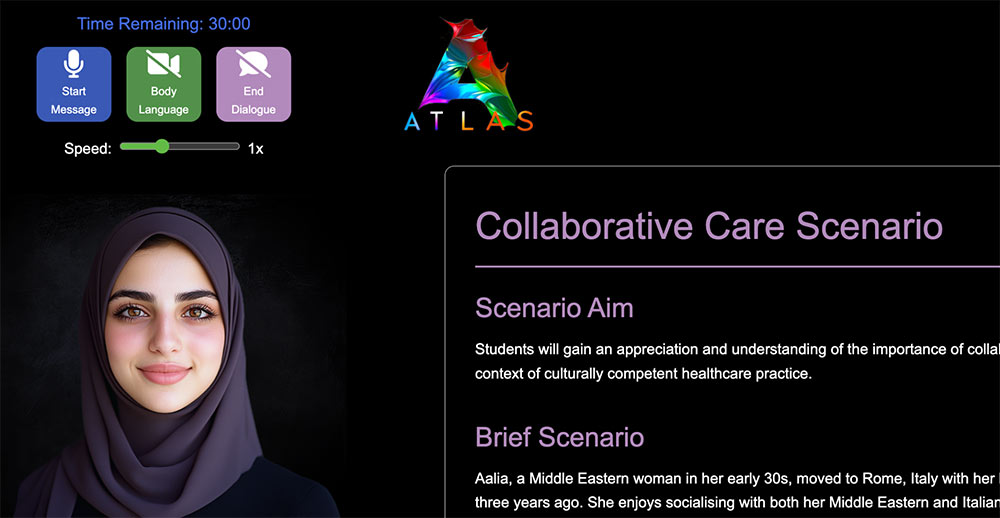
ATLAS was a way for students to practice communicating with a patient in a low stakes and unassessed environment where they could make mistakes, try out different things and practice the way they word things and to see how a patient, in this case a virtual patient, would respond to them.
-
We created personas with different personality traits based on what students are likely to see when they're practising. We might make some a little bit anxious about what's happening with their health or we might make some extremely chatty or very forthcoming with information and others not really wanting to share as much, so students really need to put a lot of effort into that communication experience.
We still give students access to the same information that they would get in the real world, whether it's if it's an outpatient, it'd be a doctor's letter. If it was an inpatient, it would be the medical record.
So we have quite a range of different personas that we've developed and we match those up with things we're trying to teach in the classroom.
We teach 12 different clinical topics like renal, liver, gastro, surgery, oncology, etc. So we tried to come up with a case for each of those different conditions and different types of patients to be able to have access to one case per week that they can use through the ATLAS program.
Depending on what we want the students to practice, we would either give students access to a particular case before class. For example, students could:
Practice gathering information before class.
A key skill for a dietitian is to be able to collect diet eating pattern information from patients. So we might ask the students to gather information, called a diet history about normal foods that patients eat, and bring that to the classroom where we'll work on a nutrition care plan together. Previously we would have to give them the diet history written on a piece of paper but that's not true to practice. No patient ever just hands us a piece of paper that says this is what I eat. So they have to know how to collect that data in the real world.
Practice certain key or discrete skills with a patient.
For example, collecting a weight history to understand how a patient's weight has changed or collecting things that might be hard or uncomfortable to talk about as a novice, like bowel habits or alcohol consumption.
Practice education giving.
This is another big part of what dietitians do. Once they've collected all their data and they've come up with a diagnosis, they can practice how to take all that technical knowledge that they have about the diet and disease relationship and provide it to a patient in a way that's easy for the patient to understand. Having someone that can reply back to them allows them to practice the teach back method, which is how we take students to make sure patients understand what they've been told. -

Positive first impressions
The students overall are generally really positive about it. When they first used the ATLAS platform, they're pretty impressed. You can hear them going “whoa, this is really cool!”
Access outside of class, value of using it in the classroom
We give students access to ALTAS outside of class time as well. Some students definitely interact with it more than others. One thing I've taken away from the evaluation is that students really value using it in the classroom
and not everyone uses it at home. Most students(97%) have accessed it in their own time, but the students that haven't just cited that they had too much other work and they couldn't fit it in.
Personalised automatic feedback
One of the huge benefits of the ATLAS platform is the feedback it can provide. There's a “get my feedback” button that students click at the end that provides automatic feedback as a PDF based on the evidence based framework that we use on placement
and in the classroom and embedded in the platform. It provides personalised feedback, even to the level of quoting things the students have said back to them and explaining how that was used and why that did or didn't work. Students definitely really value the feedback. Students do definitely come back
to it when they really see where their learning needs are, and in practice it's been good for them to have access to ATLAS while on placement as well.
Peer feedback versus personalised feedback
One of the other ways we do feedback in the classroom is peer feedback. We use live simulation where students play a patient or the dietitian and they do a consultation like they would in real life. However, Students have told us that the feedback isn’t as good because I think they're often afraid to say something that might upset their peers, so they're not always honest with their feedback. That or they are a novice too, so they don't really know how something could be made better.-
Student feedback 1
[ATLAS FEEDBACK is] just fact-based, straightforward… I don't think you could receive feedback like that from a peer, because there is that personal side of it that would… would change it.
-
Student feedback 2
[ATLAS FEEDBACK] acknowledges open and closed questions… Um, it even… talks about natural transitions between topics, which I think is… is really valuable as you learn to... develop that, um… professional relationship with… with… and rapport.
What’s next
We have looked at the relationship between the use of ATLAS and an oral interview assessment task, which is directly related to communication skills, but we didn't find any significant associations between the students that used ATLAS more and the grade for that assessment task.
I'm really interested to repeat that next year as we embed it more into the curriculum and teach the students better how to use the feedback and integrate it more into the classroom to see whether that doesn't make a difference if they've got more exposure and access to it.
It's taken a while to develop enough cases to be able to use it the way I really want to. So I'm really excited to see whether there is more of an impact in the first semester of next year
We don't use it for assessment yet but there's definitely ways ATLAS could be used in assessment, from a formative assessment perspective or if students were doing reflection so it wasn't dependent on what the avatar or the persona said.
We're in the process of evaluating student transcript data because we want to make sure that the persona is consistent with what it tells the student about itself before we use it for any assessment. So we haven't used ATLAS for assessment yet but we're doing some evaluation work on that at the moment.
-
Try it out
This exemplar is easy to implement.
Recommended resources and training:
- Contact ATLAS.AI@monash.edu to work with the ATLAS team to create a specialised application for your educational use case.
-
From the user side, the setup of ATLAS is actually remarkably easy. It probably takes us only about ½ - 1 hour to come up with ideas for each persona. Then we used an Excel sheet database to put the information about the personas that we wanted to create (see Supporting resources for an example).
Joel and his team took care of the backend coding to create the personas. Then there's a lot of testing that happens to make sure their responses and what we would expect and we can do some tweaking around that if they're not. This testing is done by the developer of the case and often takes 4-6 hours to ensure the responses are as expected.
I would recommend ATLAS as a way for students to practice communicating in a low stakes and unassessed environment where they can make mistakes and repeat their practice to improve.
-
- Embedding ATLAS into the classroom and showing students how valuable it is makes a big difference in the amount of use that it gets.
- We found that students don't really understand how valuable feedback is unless we have an activity related to that feedback in the classroom. So that's something we're going to bring in next year. We're going to have students do a whole consultation at home and bring in the feedback they received, and we'll have some sort of activity in the classroom related to that feedback. The reality is, even when they're out on their placement and they get feedback from an educator, educators are often busy with their own workload so this feedback is quite a lot more detailed than a peer would give, or even a supervisor. So helping the students understand how to use that feedback and how to incorporate it into their learning is really important.
Supporting resources
Here are some additional resources that you can browse to help you implement this assessment.